You’ve done the stretches. You’ve iced it, heated it, rested it. Maybe you’ve been adjusted, maybe you’ve had massage, maybe you’ve taken the anti-inflammatories. The pain got a little better — and then it came back.
If this sounds like your life, you’re not being dramatic. And your body isn’t broken. There’s a specific physiological reason chronic pain sticks around even when you do everything right — and most patients never hear about it until they’re months or years into the cycle.
The Problem Under the Problem
When muscles are overloaded, injured, or forced to compensate for weakness or structural imbalance, they can develop what’s called a myofascial trigger point or tender spot— a small, hyperirritable knot within a muscle fiber that refuses to release.
Trigger points aren’t just sore spots. They have a specific physiological signature. Under examination, they produce a predictable referral pattern — pain that travels to a location distant from the knot itself. The upper trapezius, for example, commonly refers pain up into the skull and behind the eye, mimicking tension headaches. The piriformis refers into the buttock and down the leg, mimicking sciatic nerve pain. The subscapularis — deep in the shoulder — can produce pain patterns diagnosed incorrectly as rotator cuff tears.
This is why patients end up chasing their pain to the wrong location, treating the symptom rather than the source. With dry needling our goal is to treat the tender spot, sure we might hit a trigger point, but it’s not the aim.
Why Standard Treatment Often Misses Them
Standard care — including stretching, exercise, anti-inflammatories, and even spinal adjustments — addresses real and important problems. But tender spots often sit outside the reach of these interventions for a simple reason: the dysfunction is happening at the neurological level within the muscle fiber itself.
A tender spot exists because a band of muscle fibers is locked in sustained contraction. That contraction cuts off the local blood supply, which causes metabolic waste to accumulate in the tissue, which irritates the local nerve endings, which signals the muscle to contract harder. It’s a self-perpetuating cycle — and it doesn’t respond to rest because the muscle can’t actually relax on its own. It doesn’t respond to stretching because you can’t passively lengthen a muscle that’s neurologically locked.
Massage helps temporarily by increasing local circulation and applying pressure that briefly interrupts the cycle. But unless the underlying cause is addressed — the structural issue, the compensation pattern, the posture that created the loading — the tender spot returns.
The Most Misunderstood Thing About Pain Referral
Most people assume pain is located where the damage is. Cut your finger, the pain is in your finger. That makes sense.
But muscles don’t follow that logic. They refer pain through established neurological pathways, and those pathways don’t match up neatly with anatomy. A trigger point in your neck can produce jaw pain. A trigger point in your mid-back can produce chest tightness that gets worked up as a cardiac issue. A trigger point in the hip flexor can drive chronic low back pain that doesn’t resolve with lumbar treatment.
This isn’t fringe science — it’s been mapped and documented since Dr. Janet Travell and Dr. David Simons published their foundational research on myofascial pain in the 1980s. But it still doesn’t make it into most standard medical workups, which is why patients with clear trigger point presentations spend years being told their pain is “nothing on imaging” or “probably stress.”
Imaging doesn’t reliably show trigger points. That doesn’t mean they aren’t there.
*But again, while we do see trigger points in patients, we aren’t specifically looking for them. Tender spots are tender under your finger, so even if it doesn’t refer pain somewhere else, we still want to treat that area.
The Physical Exam That Changes Things
A thorough hands-on assessment changes the picture entirely. When a provider palpates through the muscle belly and locates the taut band — the ropy, contracted section within the muscle — and then presses on the trigger point itself, two things typically happen:
The patient reports their familiar pain — often in a location away from where the provider is pressing.
The patient says some version of “That’s exactly it. That’s the pain I’ve been dealing with.”
That moment of recognition — when the referral pattern maps perfectly to the patient’s symptom — is diagnostic. It tells the provider that the tender spot is either the source of the pain or a significant contributor to the pain pattern.
From there, treatment decisions become clearer.
What Dry Needling Does That Other Treatments Can’t
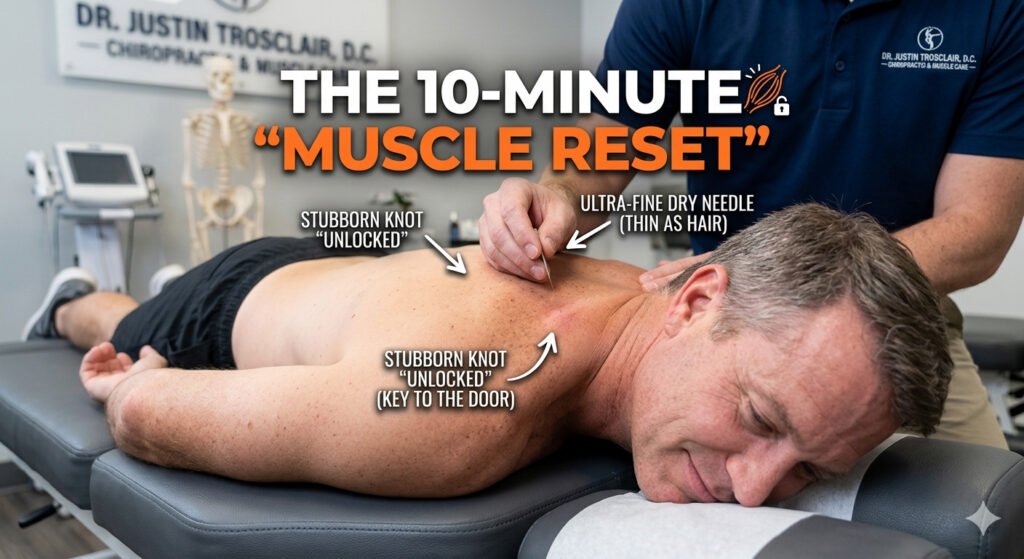
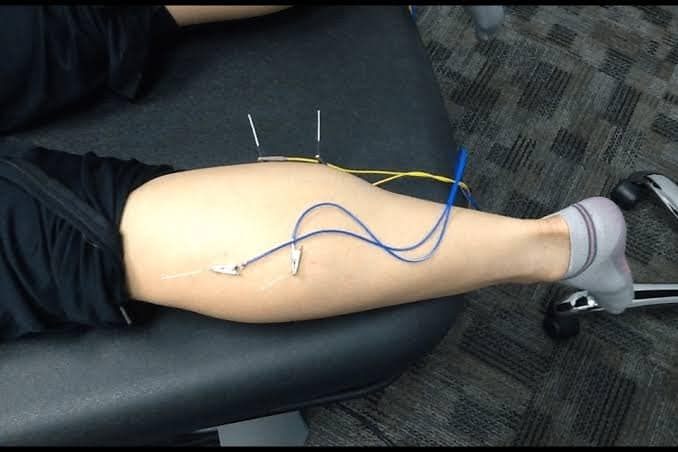
Dry needling inserts a thin monofilament needle directly into the trigger point. The goal is to produce a local twitch response — a brief, involuntary contraction of the muscle fiber that indicates the needle has engaged the dysfunctional tissue.
That twitch matters because it represents a neurological reset. The contraction cycle that was locked in place gets interrupted. Blood flow returns to the tissue. The chemical environment changes. The muscle’s ability to lengthen and respond to normal movement is restored.
Patients often describe one of two experiences:
A deep, achy pressure during the twitch that quickly fades into relief
An immediate reduction in the referred pain pattern they’ve been living with
Some feel significant improvement within 24 to 48 hours. Some need two or three sessions before the trigger point is fully resolved, particularly if it’s been present for months or years. Either way, the mechanism is direct — it’s not about the surrounding tissue, it’s not systemic, it’s not waiting for inflammation to calm down. The needle goes to the problem and addresses it mechanically.
When Dry Needling Makes Sense in Your Care Plan
Dry needling isn’t a standalone cure. It’s most powerful as one layer of a comprehensive approach.
If structural problems are driving compensation patterns that create trigger points, those structural problems still need to be addressed. If poor posture is loading the upper traps and creating headaches, posture work still matters. Dry needling addresses the muscular layer — the knot that’s generating pain right now — so that the other work can do its job more effectively and hold longer.
Patients who tend to see the most benefit from dry needling:
Those with chronic pain (low back pain for instance) that hasn’t resolved with standard conservative care
Those whose pain refers or travels in ways that don’t map cleanly to their diagnosis
Those who feel tight or guarded after adjustments or decompression — the muscles keep pulling things back
Those dealing with headaches, jaw pain, or facial pain with a suspected cervical or upper trap component
Those recovering from acute injury where muscles have gone into protective spasm
The Question Worth Asking
If you’ve been in pain for more than a few weeks, if you’ve done what you were told to do and the relief isn’t sticking, the question worth asking your provider is simple: “Is there a tender spot component to this, and have we addressed it?”
If the answer is no — or uncertain — that’s a conversation worth having. The cycle you’re in might be breakable. It might just require targeting the right layer.
Dr. Justin Trosclair, D.C. incorporates dry needling into comprehensive spinal and musculoskeletal care at his Lafayette, Louisiana clinic. If your pain keeps coming back and standard treatment hasn’t held, reach out to schedule a consultation. 1 337 453 5199 to discuss your specific situation.