
Your Low Back Pain Isn’t a Life Sentence. Here’s What’s Actually Keeping It Stuck.
You’ve learned to manage around it.
You know which positions make it worse. You know the morning is hard. You know that sitting too long or standing too long both eventually make the same spot ache. You’ve figured out how to get out of bed in a way that doesn’t set it off.
And somewhere along the way, you stopped calling it a problem and started calling it just how your back is.
That shift — from “I have a problem” to “this is just how I am” — is one of the most expensive things chronic pain does to people. It doesn’t just take away comfort. It takes away the expectation that things could be different.
Here’s what’s worth knowing: a significant portion of the low back pain that people resign themselves to isn’t structural, isn’t permanent, and isn’t untreatable. It’s muscular. Specifically, it’s driven by myofascial trigger points and tender spots — hyperirritable knots in the muscles of the lower back and hips that sustain a pain cycle that standard care often doesn’t reach.
What’s Actually Happening in Your Lower Back
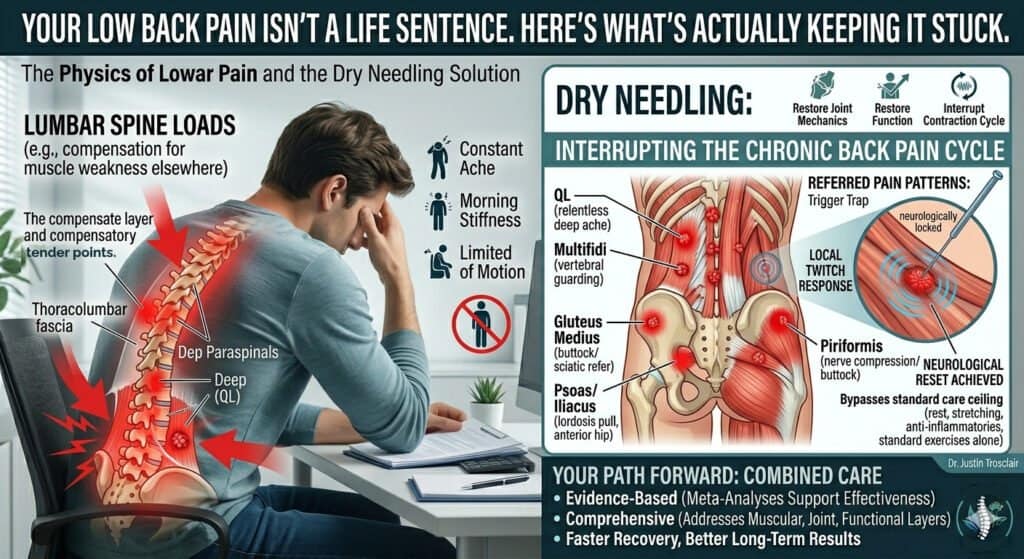
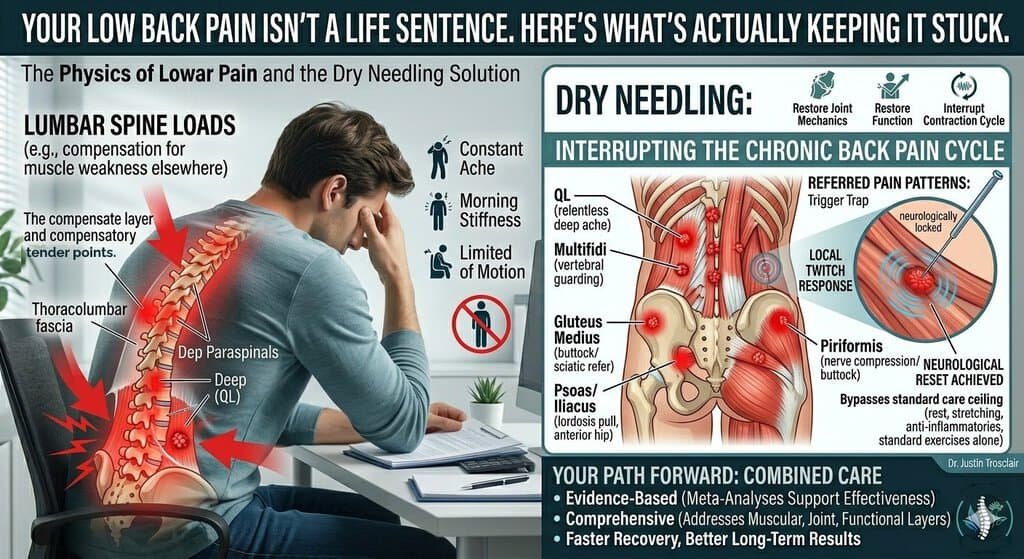
The muscles surrounding the lumbar spine are among the most load-bearing in the body. The thoracolumbar paraspinals, the multifidi, the quadratus lumborum, the gluteals, and the hip flexors all work together to support, stabilize, and move the spine. When any part of that system is disrupted — by injury, by poor posture over years, by compensating for weakness elsewhere — other muscles pick up the slack.
Muscles that work overtime develop trigger points. Those trigger points are taut, contracted bands of muscle fiber that cut off their own blood supply, accumulate metabolic waste, and irritate the local nerve endings enough to generate persistent pain. They refer that pain in predictable patterns — often into the buttock, the hip, the groin, and down the back of the leg in patterns that are frequently misidentified as disc or nerve problems.
The quadratus lumborum — a deep muscle running from the lower ribs to the top of the pelvis — is one of the most common sources of chronic low back pain that doesn’t respond to standard treatment. When it harbors trigger points or more generally tender spots, it produces a deep, aching pain across the low back that worsens with movement and never fully resolves with rest. It’s often invisible to imaging. It responds very well to dry needling.
Why You’re Doing Everything Right and Still Hurting
This is the question that frustrates patients most. They’re stretching. They’re doing the exercises. They may be getting adjusted regularly. Some improvement, yes — but the pain keeps returning to the same baseline.
The answer usually comes down to what’s not being addressed.
Stretching lengthens muscles but cannot release a trigger point / tender spot that is neurologically locked. You can stretch the low back for 20 minutes and temporarily relieve tension without ever disrupting the contraction cycle inside a tender spot / trigger point — the knot simply reloads as soon as you stop.
Anti-inflammatories address the inflammatory component of pain but do nothing for the degenerative or myofascial component. Research has increasingly shown that what we’ve historically called “muscle inflammation” in chronic low back pain is often better understood as fasciopathy — degenerative tissue change — not acute inflammation. The ibuprofen calms the edge. It doesn’t fix the tissue.
Spinal adjustments restore joint mechanics and are genuinely valuable. But a joint that gets adjusted and then gets pulled back out of position by chronically contracted surrounding muscles is fighting against the treatment every time. The muscular layer has to be addressed for the joint work to hold.
What the Research Shows
The evidence base for dry needling in low back pain has grown substantially in recent years and is among the strongest in the entire field of musculoskeletal care.
* A 2025 meta-analysis — one of the most comprehensive to date — synthesized data from 13 randomized controlled trials involving 590 patients with chronic low back pain. The findings were clear across multiple outcome measures: dry needling produced a significant reduction in pain intensity, with a standardized mean difference of -0.78, and a significant improvement in functional disability, with a standardized mean difference of -0.64. Both results were statistically robust. The same analysis found meaningful improvements in pressure pain threshold — essentially how sensitive and reactive the painful tissue was — with those gains maintained at follow-up.
* A 2024 randomized controlled trial published in Spine Journal found that electrical dry needling used as an adjunct to conventional physical therapy produced significantly better outcomes in patients with lumbar spinal stenosis than physical therapy alone — with improvements in both pain and function.
* A 2023 systematic review and meta-analysis published in peer-reviewed literature — synthesizing data from 8 randomized controlled trials involving 414 patients — found that dry needling significantly reduced pain intensity compared to other treatments both immediately post-intervention and at short-term follow-up.
The picture that emerges from this research is consistent: dry needling works, it works better when combined with other care, and it addresses the layer of the pain problem that most standard treatments leave untouched.
The Muscles That Matter Most
For a patient with chronic low back pain, the trigger point assessment follows a predictable anatomical logic. The muscles that carry the most compensatory load and develop trigger points most reliably are:
Quadratus lumborum (QL) — the deep muscle from lower rib to pelvis that is arguably the most underdiagnosed source of chronic low back pain. QL trigger points and tender spots produce a deep, relentless ache that worsens with prolonged sitting or standing and refers into the hip and buttock. Patients often describe it as a “bone-deep” ache that nothing touches.
Lumbar paraspinals and multifidi — the muscles running along the spine. Trigger points and tender spots here produce the classic “back pain” pattern and contribute to the muscle guarding that makes low back pain feel like it’s locked in place.
Gluteus medius and minimus — trigger points and tender spots in these hip muscles refer pain down the outside and back of the leg in patterns that closely mimic sciatica. Many patients diagnosed with “sciatica” are actually dealing partly or entirely with gluteal trigger points.
Psoas and iliacus — deep hip flexors that become overloaded in people who sit for prolonged periods. Trigger points and tender spots here pull the lumbar spine into excessive lordosis, compress the lumbar discs, and generate anterior hip and low back pain that stretching alone cannot resolve.
Piriformis — when tight and trigger-pointed, this muscle can compress the sciatic nerve and produce buttock and leg symptoms. It’s one of the most common contributors to the “sciatica that imaging doesn’t explain.”
How This Fits Into Your Care
Dry needling for low back pain isn’t a standalone treatment in isolation — it’s most powerful as a targeted layer within a comprehensive approach. The needle addresses the trigger point and tender spots directly, resets the muscular contraction cycle, and restores the tissue environment so that the other work — the adjustments, the exercise, the decompression — can do its job more effectively and hold longer.
Patients who have plateaued in their care, who feel like they improve slightly and then revert, are often the ones who benefit most. The plateau frequently signals that the muscular layer hasn’t been addressed.
Your 3-Step Path Out of This
You don’t have to keep managing around your back.
Step 1 — Get assessed properly. A thorough hands-on examination identifies which muscles are harboring trigger points and whether they’re driving your pain pattern. This takes minutes and often explains symptoms that months of imaging hasn’t.
Step 2 — Target the source directly. Dry needling goes into the trigger point and tender spots, produces the local twitch response that resets the muscle, and allows the tissue to begin the healing process it couldn’t complete on its own.
Step 3 — Let the rest of your care work. With the muscular layer addressed, your adjustments hold longer, your exercises activate correctly, and the pattern that kept pulling you back to the same baseline gets interrupted.
The back you’ve been managing around is still the same back. It just hasn’t had the right tool applied to the right problem yet.
Dr. Justin Trosclair, D.C. offers dry needling as part of comprehensive chiropractic and musculoskeletal care in Lafayette, Louisiana. If chronic low back pain has become your normal, schedule a consultation to find out whether trigger points are part of what’s keeping it that way.
Scoliosis Center of Louisiana
Dr. Justin Trosclair, DC
📞 337-453-5199 Call or Text Today to get scheduled
Serving Lafayette, Youngsville, Broussard, Scott, Carencro, and surrounding Acadiana communities.