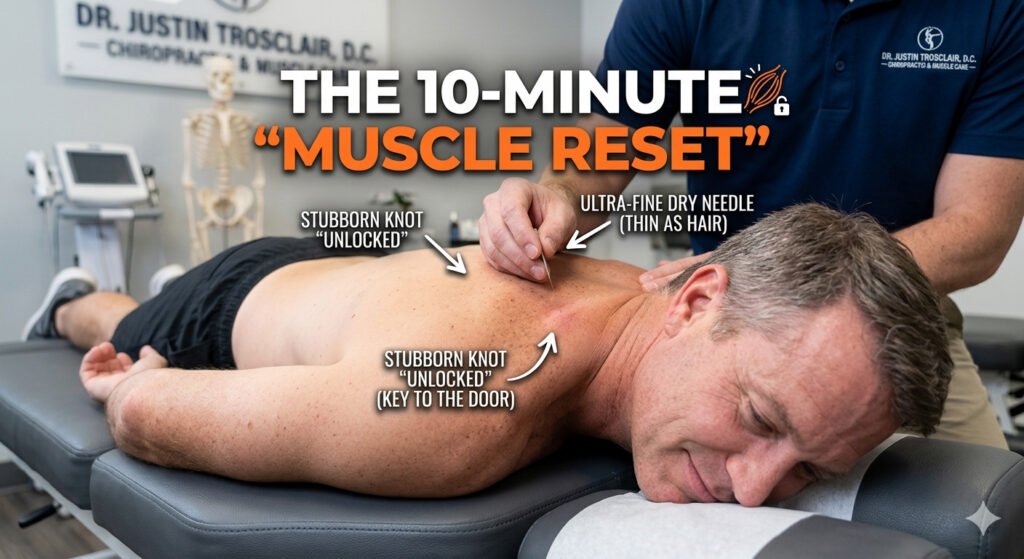
Most conversations about scoliosis focus on the curve — the Cobb angle, the degree of rotation, whether it’s progressing. Those numbers matter. But there’s a layer of the scoliosis experience that doesn’t show up on X-ray and rarely gets addressed in standard treatment plans: what’s happening in the muscles surrounding an uneven spine.
If you’re a scoliosis patient dealing with chronic muscle pain, tightness, and fatigue that your brace, exercises, or adjustments haven’t fully resolved — this is for you.
What a Scoliosis Curve Does to the Muscles Around It
A spine with a lateral curve and rotational component doesn’t just pull bones into abnormal positions. It creates a profound imbalance in the muscular system on both sides of the curve.
On the convex side (the outside of the curve, where the rib cage tends to protrude), muscles are stretched chronically. Chronically elongated muscles become fatigued and develop tension as they work constantly just to hold the spine from collapsing further into the curve. They feel tight even though they’re actually overstretched — a common source of confusion for patients who stretch and never get relief.
On the concave side (the inside of the curve), muscles are chronically shortened. They develop dense, fibrotic texture over time and restrict the range of motion that corrective exercise and bracing are trying to restore.
Both sides develop tender spots. Both sides generate pain. And because the pattern is driven by structural imbalance rather than overuse or acute injury, those tender spots don’t resolve on their own.
The Pain That Bracing and Exercise Don’t Fully Reach
ScoliBalance exercises and ScoliBrace bracing work at the structural level — they address spinal position, rib cage rotation, and postural compensation. They are essential tools, and they produce measurable changes in curve progression and posture over time.
But here is what they cannot fully address: a muscle that is neurologically locked in a tender spots state isn’t going to respond normally to corrective movement. You can prescribe a strengthening exercise for the right mid-back, but if the muscle is harboring trigger points that are keeping it in a contraction-inhibited state, it won’t activate the way it needs to. The brain sends the signal; the muscle can’t fully receive it.
This is why scoliosis patients often describe a plateau — they’re doing everything right, the brace is fitting well, the exercises are consistent, but there’s a specific zone of tightness and ache that won’t budge. In many of these cases, the muscular layer needs direct treatment before the corrective work can land the way it’s designed to.
What the Research Shows
The research base on dry needling for musculoskeletal pain conditions is growing steadily. Studies have consistently shown that trigger point dry needling:
Reduces pain intensity in the treated area
Improves range of motion restricted by myofascial tightness
Decreases pressure pain threshold (meaning the muscles become less sensitive and hyperreactive)
Produces changes in local blood flow and tissue chemistry that support healing
While research specifically on dry needling within a scoliosis population is still emerging, the mechanism is directly relevant. Scoliosis patients carry the same tender spots as other musculoskeletal patients — they just carry them in predictable, structurally-driven patterns, and in higher concentrations than average given the chronic compensatory loading their spines create.
Clinical experience in practices that combine spinal corrective care with dry needling consistently shows one clear pattern: patients move better, feel less guarded, and respond more positively to corrective exercise and bracing when the muscular layer has been treated.
The Muscles That Matter Most in Scoliosis
For a clinician familiar with scoliosis biomechanics, tender spot assessment in a scoliosis patient is a predictable process. The muscles that bear the most compensatory load and develop tender spots most reliably include:
Thoracic paraspinals — the muscles running along the spine in the mid-back. On the concave side, these become chronically shortened and dense, restricting corrective movement. On the convex side, they fatigue from the work of holding against the curve.
Quadratus lumborum (QL) — the deep lower back muscle that becomes asymmetrically loaded in lumbar curves and pelvis-level compensation. QL trigger points are one of the most common sources of chronic low back pain in scoliosis patients and one of the most satisfying to treat with dry needling.
Thoracic rotators and multifidi — small, deep muscles along the spine that become heavily strained in rotational curves. They rarely respond to surface massage because they’re too deep to reach manually with enough precision.
Psoas and hip flexors and outside of the leg It band — when lumbar curves shift the pelvis, these muscles adapt and develop trigger points that pull the lumbar spine into further dysfunction.
Upper trapezius and cervical paraspinals — particularly in patients with thoracic curves that produce secondary cervical compensations. Upper back curve patients commonly present with neck pain, headaches, and shoulder asymmetry driven partly by trigger points in these areas.
How It Fits Into a Comprehensive Scoliosis Care Approach
Dry needling in a scoliosis patient isn’t a separate treatment track — it’s a targeted addition to the work already underway. The sequence typically looks like this:
First, the structural picture is understood — curve location, rotation, compensatory patterns. From that, a clinical assessment identifies which muscles are carrying the most compensatory load and which are harboring trigger points contributing to the patient’s pain.
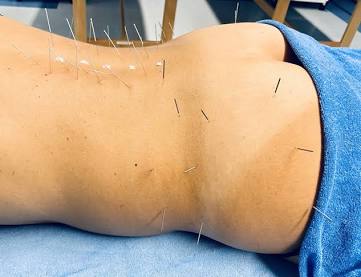
Dry needling is then used to address those tender spots directly, before or alongside corrective exercise sessions. The patient’s muscles are in a better neurological state to respond to the movement work that follows.
Over time, as the curve is managed and posture improves, the muscular load pattern shifts — and the trigger point burden often decreases because the structural driver is being addressed.
The key word is comprehensive. Neither the structural work nor the muscular work alone produces the best outcomes. Together, they address the full picture of what scoliosis does to a body.
A Word About Pain and Scoliosis
There’s a persistent misconception that scoliosis pain is primarily driven by the curve itself — and that until the curve changes, the pain won’t change. This leads patients to accept a level of daily pain as inevitable.
The reality is more nuanced. While significant curves do create structural load that contributes to pain, a substantial portion of the day-to-day pain scoliosis patients experience is muscular. It comes from the trigger points in chronically overloaded muscles, the fatigue of asymmetric effort, and the neurological sensitization that develops in chronically painful tissue. That pain is treatable — now, even while structural work is ongoing.
You don’t have to wait for the curve to improve to feel better. The muscular layer can be treated directly and meaningfully while the structural correction is in progress.
Is Dry Needling Right for Your Scoliosis?
Not every scoliosis patient needs dry needling. But patients who are experiencing persistent muscle pain, fatigue, tightness that doesn’t resolve with exercises and bracing alone, or a plateau in their corrective care response are good candidates for an assessment.
The evaluation involves hands-on palpation to identify trigger points, assessment of referral patterns, and a conversation about where your care plan stands and what the muscular picture might be contributing to your symptoms.
Dr. Justin Trosclair, D.C. is a ScoliCare Level 2 ScoliBalance certified provider and ScoliBrace provider serving scoliosis patients from across Louisiana and surrounding states. Dry needling is now available as part of the comprehensive spinal care approach at his Lafayette, Louisiana clinic. To discuss whether dry needling fits your current care plan, schedule a consultation. 1 337 453 5199 to discuss your specific situation.