

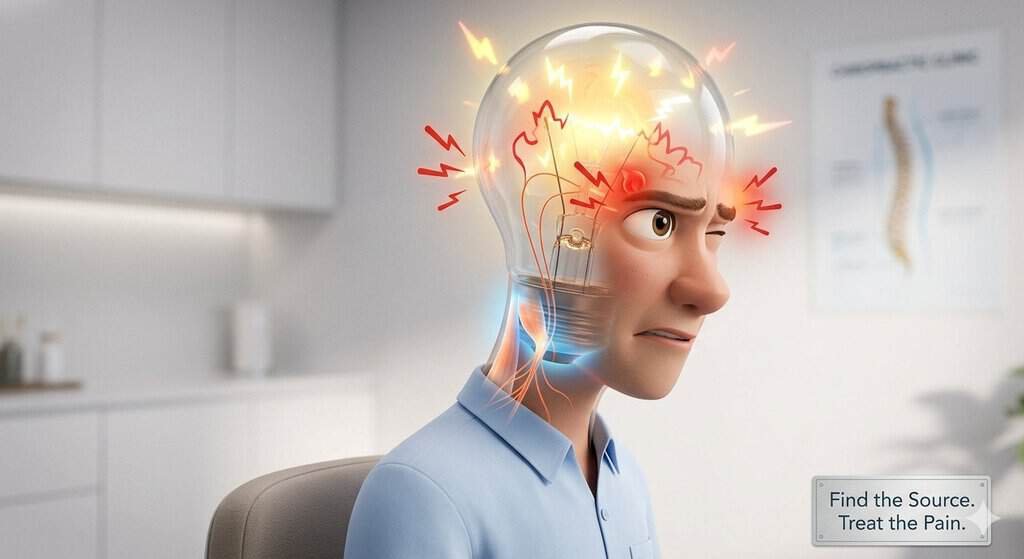
The Headache That Keeps Coming Back Isn’t in Your Head — It’s in Your Neck.
You’ve had this headache before.
It starts at the base of your skull, crawls up the back of your head, and settles somewhere behind your eye. Some days it’s a dull pressure. Some days it throbs. Some days you just feel like you can’t think straight.
You’ve taken the ibuprofen. You’ve tried the dark room. You’ve had the MRI that showed “nothing significant.”
And the headache came back anyway.
Here’s what nobody told you: a significant percentage of chronic headaches — the recurring kind, the ones that don’t make sense on imaging — originate in the muscles and joints of your neck, not inside your skull. And the treatment for a muscle problem is completely different from the treatment for a neurological one.
Until you address the right source, you’re managing symptoms. Not solving the problem.
Your Neck Is Running Your Head (More Than You Think)
The suboccipital muscles — four small, deep muscles at the base of your skull — have one of the highest concentrations of nerve receptors of any muscle group in the human body. They’re extraordinarily sensitive. And they have a direct neurological relationship with the trigeminal nerve system that drives most of the pain signals we perceive in the head and face.
When those muscles develop trigger points — tight, hyperirritable knots that form under chronic postural load, stress, or injury — they don’t just hurt where they are. They refer pain up into the skull, behind the eye, across the temple, and into the forehead. They can produce symptoms that look identical to tension headaches, migraines, and sinus headaches.
The upper trapezius, the sternocleidomastoid (the big muscle running down the side of your neck), and the cervical paraspinals all do the same thing. All have well-documented referral patterns directly into the head.
This is why people spend years treating “headaches” without getting lasting results — the headache is real, but the address is wrong.
What the Research Actually Shows
This isn’t theory. The research on dry needling for headaches is substantial and growing.
A 2021 systematic review and meta-analysis published in Physical Therapy — one of the most rigorous journals in musculoskeletal medicine — examined the effectiveness of dry needling across tension-type headaches, cervicogenic headaches (those originating from the neck), and migraines.
The findings were striking. For tension-type headaches, the analysis found that for every one to two patients treated with dry needling, one patient showed a meaningful decrease in headache intensity. The effect on disability — how much the headache was interfering with daily life — was even larger, with a number needed to treat of just one. That’s an unusually strong result in clinical research.
For cervicogenic headaches — the neck-driven kind — dry needling produced significant improvements in both pain intensity and related disability across multiple studies.
A 2024 randomized controlled trial published in the Journal of Personalized Medicine specifically examined dry needling’s effect on active trigger points in tension-type headache patients and confirmed meaningful reductions in both trigger point activity and headache pain intensity following treatment.
The mechanism behind these results isn’t mysterious. Dry needling produces a local twitch response in the tender spot — a brief, involuntary contraction that interrupts the neurological contraction cycle. Blood flow is restored. The chemical environment in the tissue changes. The referral pattern that was driving pain into your head quiets down.
How to Know If Your Headache Is Coming From Your Neck
There’s a clinical pattern that shows up consistently in patients whose headaches have a cervical component. You don’t need a diagnosis to recognize it — you just need to pay attention to what’s actually happening.
Your headache starts or worsens after being at a screen. Forward head posture dramatically increases the load on the suboccipital muscles and cervical paraspinals. An hour hunched over a laptop can load those muscles the equivalent of carrying a 40-pound weight on your neck. Trigger points / tender spots form under that kind of sustained stress.
Your headache is one-sided, or always worse on the same side. Trigger points in the upper trap, SCM, and suboccipitals tend to refer unilaterally. If your pain is reliably worse on the left or right, that’s a pattern worth investigating.
Pressing on your neck or upper shoulders reproduces your familiar head pain. This is the clearest sign. When pressure applied to a spot in your neck or shoulder sends aching pain toward your head — especially if it matches the pain you normally feel — you’ve just identified a trigger point.
You’ve been told your imaging is “normal.” Trigger points /tender spots don’t show on MRI or CT. A clean scan doesn’t mean there’s no treatable problem. It means the problem isn’t structural.
Your headaches respond temporarily to massage or heat but keep returning. Massage improves circulation and temporarily disrupts trigger point activity. But without resetting the trigger point directly, the pattern comes back as soon as the muscle reloads.
What Treatment Actually Looks Like
The assessment comes first. Before any needles, we’re mapping the pain — where it starts, where it goes, what makes it worse. We’re palpating the muscles of the neck and upper back to locate the taut bands and active trigger points / tender spots.
When we find the spot that recreates your familiar head pain under pressure, we’ve confirmed the source.
The needle goes directly into that trigger point / tender spot (see the difference between acupuncture). You’ll feel a deep, achy sensation — brief, a few seconds — as the muscle twitches and releases. For most patients treating cervical trigger points related to headaches, the referral into the head diminishes within minutes of the treatment.
Most headache patients notice meaningful improvement within 24 to 48 hours of their first session. Some need two or three sessions, particularly if the tender spots are long-established. The treatment works alongside chiropractic adjustments — the adjustment restores joint mechanics ( like a reset), the dry needling resets the muscular layer. Together, they address both sides of why the pain keeps returning.
The Question Worth Sitting With
If you’ve been managing your headaches — taking the pill, waiting it out, adjusting the monitor height — ask yourself honestly: have they gotten better over time, or have they just stayed the same?
Chronic headaches don’t have to be managed indefinitely. If there’s a muscular source, it can be treated. The tender spots can be released. The referral pattern can be turned off.
You don’t have to keep waking up with that pressure behind your eye and deciding it’s just how your days start.
Dr. Justin Trosclair, D.C. offers dry needling as part of comprehensive chiropractic and musculoskeletal care in Lafayette, Louisiana. If you’re dealing with recurring headaches that haven’t resolved with standard treatment, schedule a consultation 1 337 453 5199 to find out whether there’s a cervical trigger point / tender spot component driving your pain.