You know exactly what I’m talking about.
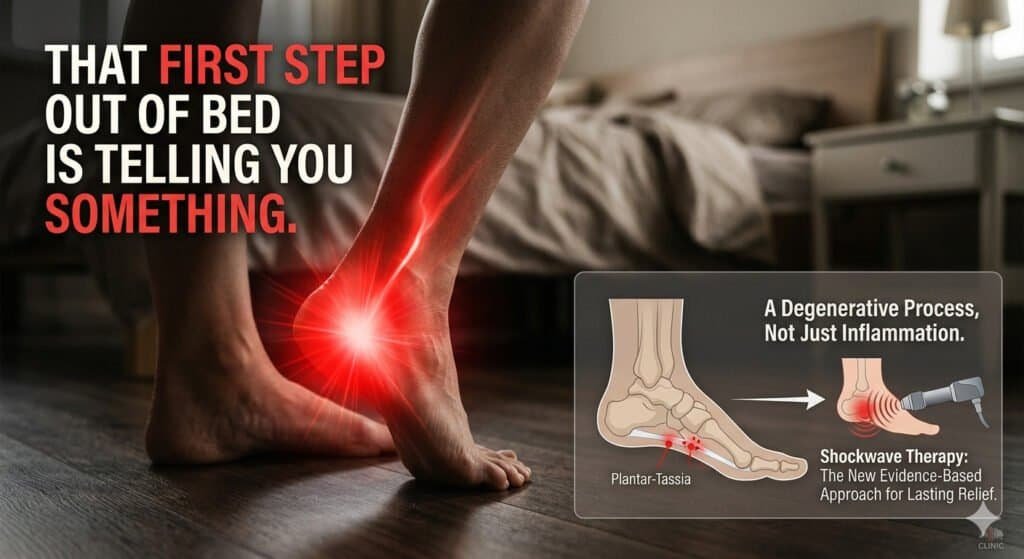
The alarm goes off. You swing your feet over the side of the bed. The moment your heel hits the floor, there it is — that sharp, stabbing pain that makes you wince before your day has even started.
You limp to the bathroom. By the time you’ve been up for ten minutes, it loosens up enough to walk. You start to think maybe it’s getting better.
Then you sit down for a meeting and stand back up an hour later, and it’s back.
That cycle — sharp pain on first steps, loosening up with movement, returning after rest — is one of the most recognizable patterns in all of musculoskeletal medicine. It’s plantar fasciitis. And if you’ve been living with it for more than a few weeks, you’ve probably already learned that ice, rest, and stretching only get you so far.
Here’s what’s actually happening in your foot, why standard treatments don’t fully solve it, and why shockwave therapy is now considered one of the most effective interventions available for this condition.
What’s Really Going On in That Heel.
The plantar fascia is a thick band of connective tissue running along the bottom of your foot from your heel bone to the base of your toes. Its job is to absorb force with every step and help maintain the arch. It does this thousands of times per day.
When it gets overloaded — from increased activity, prolonged standing, unsupportive footwear, or changes in body weight — the tissue at its attachment point on the heel develops micro-tears. The body responds with an inflammatory process designed to heal those tears.
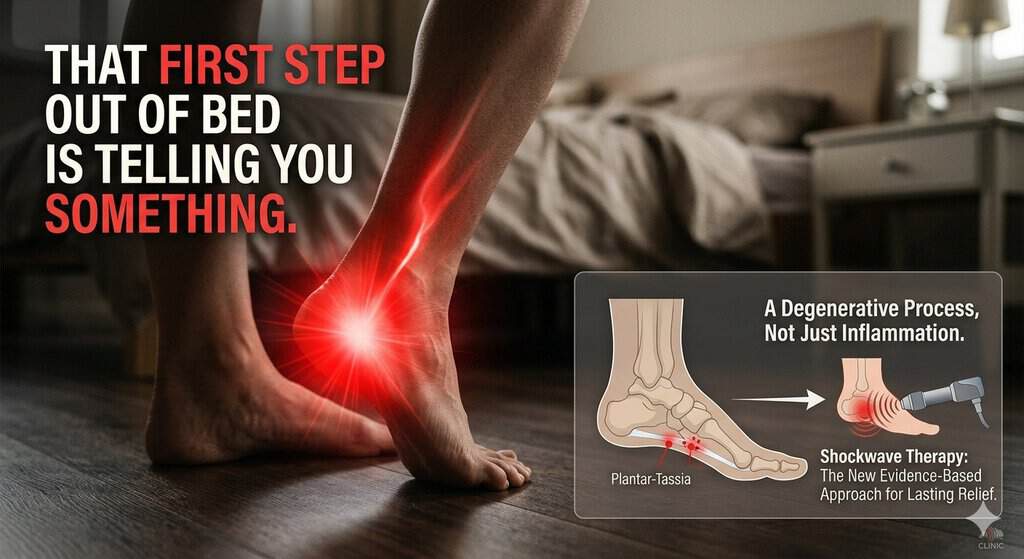
Here’s where it gets complicated. Research over the last two decades has shown that what we’ve long called “plantar fasciitis” — -itis meaning inflammation — is often better described as plantar fasciopathy: a degenerative process rather than a purely inflammatory one. The tissue isn’t just inflamed. It’s undergone structural changes. The collagen organization has broken down. The normal healing cycle has stalled.
This is why anti-inflammatories work temporarily but don’t fix it. You’re not dealing purely with inflammation — you’re dealing with tissue that has lost its ability to heal itself properly.
That changes what treatment needs to do.
Why Everything You’ve Tried Has Only Helped Halfway
Stretching the calf and plantar fascia helps manage load on the tissue. Night splints keep the fascia from tightening while you sleep, which reduces that brutal first-step pain. Orthotics redistribute pressure. All of these are genuinely useful.
But none of them restart the healing process in tissue that has become degenerative and chronically irritated. They manage the symptom environment. They don’t fix the underlying tissue problem.
Cortisone injections are worth addressing directly. They’re commonly offered for plantar fasciitis and they do reduce pain — in the short term. The problem is that cortisone is a corticosteroid, and repeated corticosteroid injections have been shown to weaken connective tissue over time. Multiple studies have linked steroid injections to plantar fascia rupture with repeated use. You get temporary relief, but you may be weakening the very structure you’re trying to heal.
Surgery is the last resort — and for good reason. Recovery is lengthy, outcomes are variable, and conservative care should be exhausted first.
That gap — between “stretching helps a little” and “I’m ready for surgery” — is exactly where shockwave therapy lives.
What Shockwave Therapy Actually Does
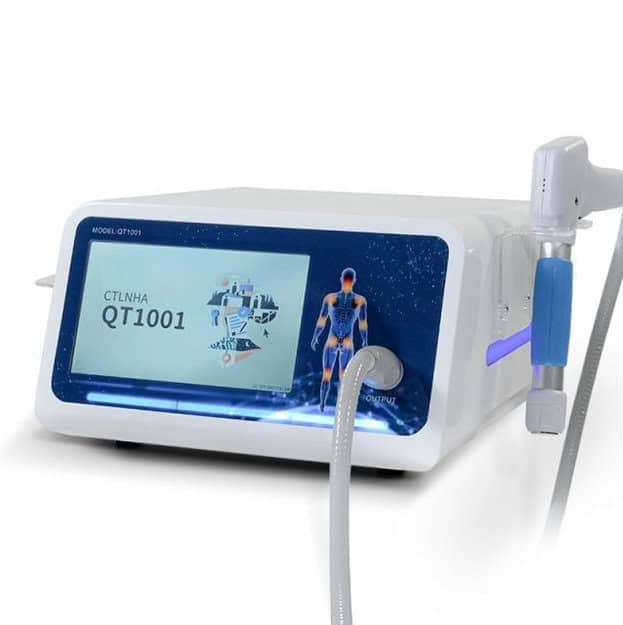
Extracorporeal shockwave therapy (ESWT) delivers high-energy acoustic waves into the tissue through a handheld device pressed against the skin. No incisions. No injections. No downtime.
Those acoustic waves create a cascade of biological effects that don’t happen with stretching or rest:
It restarts the healing response. The waves create controlled microtrauma in the degenerative tissue — essentially telling the body that there’s an injury that needs to be addressed. This triggers neovascularization: the formation of new blood vessels in an area that had become chronically underperfused. New blood supply means renewed healing.
It breaks down pathological calcification. Many chronic plantar fasciitis cases involve calcific deposits that have formed in the fascia. Shockwave therapy mechanically disrupts these deposits and allows the body to reabsorb them.
It desensitizes the local nerve endings. Over time, shockwave therapy has been shown to reduce the hypersensitivity of the nociceptors (pain receptors) in the affected tissue — which is part of why patients experience pain reduction that persists beyond the treatment itself.
It stimulates collagen synthesis. The waves promote the production of new, organized collagen — which is the raw material the fascia needs to structurally repair.
What the Research Shows
The evidence base for shockwave therapy in plantar fasciitis is one of the strongest in all of conservative musculoskeletal care.
A 2024 systematic review with meta-analysis published in European Journal of Physical and Rehabilitation Medicine analyzed randomized controlled trials and found that ESWT produced significant improvements in both pain intensity and functional outcomes in plantar fasciitis patients, with strong tolerability across the studies examined.
A separate meta-analysis examining 15 randomized controlled trials — involving over 1,100 patients — found that shockwave therapy was superior to ultrasound therapy for plantar fasciitis across multiple outcome measures including pain during activity, activity limitations, and patient satisfaction.
The research also consistently shows durability. This isn’t a treatment that produces temporary relief and fades. Studies tracking patients at 3 months, 6 months, and 1 year post-treatment show maintained improvement — because the underlying tissue has actually changed, not just been temporarily quieted.
For patients who have already tried conservative care for three months or more without adequate relief, the research supports shockwave as a highly appropriate next step before considering more invasive options. Curious about cortisone injection then read this article.
Who Is a Good Candidate
Shockwave therapy is most effective for:
- * Plantar fasciitis that has persisted for more than 6 weeks despite stretching, rest, and supportive footwear
* Patients who have had temporary relief from other treatments but can’t achieve lasting resolution
* Patients who want to avoid corticosteroid injections or have already had them without lasting benefit
* Those with calcific deposits in the plantar fascia visible on imaging
* Runners, nurses, teachers, retail workers, and anyone on their feet all day whose lifestyle makes “just rest it” an impractical instruction
It’s also well-suited for patients who’ve been managing the pain for months or years and have simply accepted it as part of their routine. You don’t have to accept it.
What the Treatment Experience Is Like
A typical shockwave session for plantar fasciitis takes about 15 minutes.
We’ll identify the most symptomatic area of the fascia — usually the medial calcaneal attachment at the heel, which is where the majority of plantar fasciitis presents. Ultrasound gel is applied to the skin. The shockwave device delivers a series of pulses to the tissue. You’ll feel a tapping sensation with some intensity over the most affected areas.
Most patients complete 3 to 5 sessions, typically spaced one week apart.
The timeline for relief varies. Some patients notice improvement after the first or second session. Others find that the full effect becomes apparent over the two to four weeks following their final session, as the tissue continues the healing process that shockwave therapy initiated. Some patients experience mild soreness for 24 to 48 hours after a session — a sign that the biological response has been activated.
The 3-Step Path to Putting This Behind You
You don’t have to keep modifying your morning routine around a painful heel. Here’s how straightforward this can be:
Step 1 — Get assessed. We confirm that what you’re dealing with is plantar fasciitis and that shockwave therapy is appropriate for your presentation. If there are other contributing factors — tight calves, gait mechanics, footwear — we identify those too.
Step 2 — Complete your shockwave sessions. Three to five sessions, about 15 minutes each. We target the fascia directly and let the acoustic waves do what months of stretching couldn’t.
Step 3 — Walk away from this. Most patients with chronic plantar fasciitis who complete a course of shockwave therapy achieve significant, lasting pain relief. The first step out of bed stops being the worst part of your morning.
One Final Thing If you’ve been living with this for months, there’s a version of you that has quietly accepted heel pain as normal. That version of you has stopped wearing certain shoes, avoids certain activities, and budgets the first few minutes of every morning around getting the foot warmed up. That adaptation was reasonable. But it doesn’t have to be permanent. The tissue can heal. The pain can resolve. And the treatment to make that happen is 15 minutes long.
Dr. Justin Trosclair, D.C. offers shockwave therapy and dry needling as part of comprehensive musculoskeletal care in Lafayette, Louisiana. If you’ve been dealing with plantar fasciitis that hasn’t responded to standard treatment, call the clinic 1 337 453 5199 or ask about shockwave therapy at your next visit.