
You’ve been dealing with pain in your heel, your shoulder, your elbow — or somewhere else that just won’t heal. Your doctor offered you a cortisone shot. It sounds simple. One quick injection and the pain goes away. Who wouldn’t want that? But here’s the thing nobody told you. That shot might quiet the pain for a few weeks. And then the pain comes back. Sometimes worse than before. There’s a reason for that. And there’s also a better way.
Why the Pain Keeps Coming Back After a Cortisone Shot
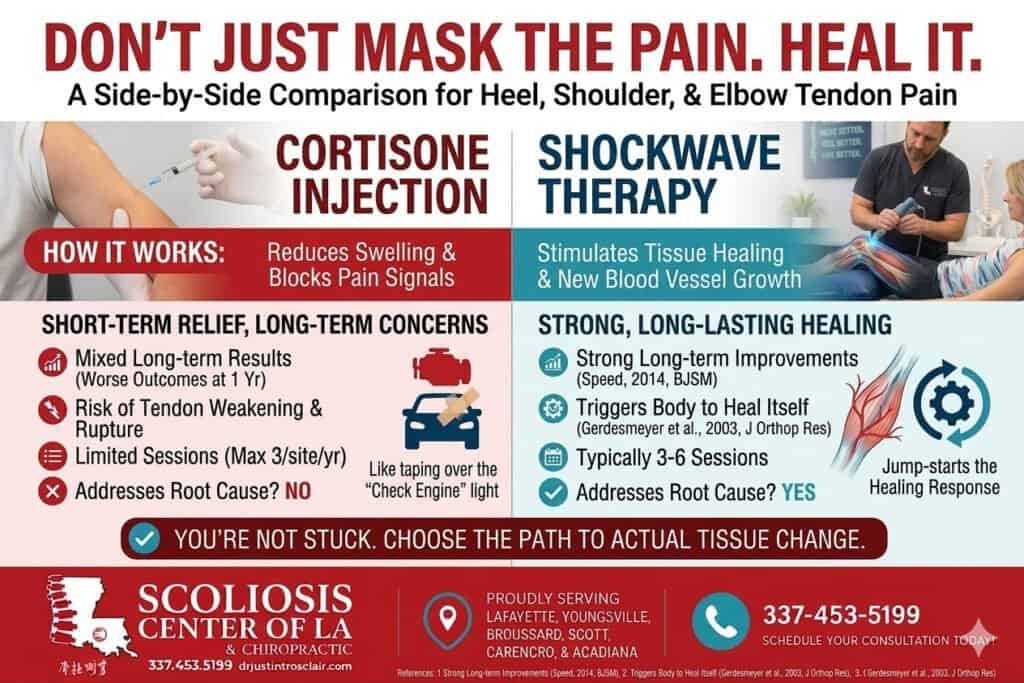
Cortisone is a steroid. It’s really good at calming down swelling and blocking pain signals. That’s why doctors use it.
But it doesn’t fix what’s wrong with your tissue.
Think of it like this. If your car’s “check engine” light comes on, you could put tape over the light so you can’t see it anymore. Problem solved, right? Not really. The engine still has the same issue.
Cortisone is a lot like that tape.
A study published in the Journal of the American Medical Association (JAMA) followed 165 patients with plantar fasciitis (heel pain) over two years. The group that got cortisone injections had faster short-term pain relief. But at the one-year and two-year marks, they actually did worse than the group that didn’t get the shot (Landorf et al., 2006, JAMA Internal Medicine).
Another major review in the Lancet looked at 41 studies with over 4,000 patients. It found that cortisone injections for conditions like tennis elbow had “significantly worse outcomes” in the long term compared to doing other treatments — or even doing nothing (Coombes et al., 2013, Lancet, 381 patients in key arm of study).
That’s not a small footnote. That’s a big deal.
And on top of that? Cortisone shots carry real risks, including:
- Weakening of the tendon (and in rare cases, rupture)
- Thinning of skin and tissue around the injection site
- Temporary blood sugar spikes, especially for people with diabetes
- A “post-injection flare” where pain gets worse for 2–3 days after the shot
Most doctors will tell you not to get more than three cortisone shots in the same spot per year. That alone tells you something — it’s not meant to be a long-term solution.
So What Does Shockwave Therapy Actually Do?
Shockwave therapy does something completely different. Instead of masking pain, it triggers your body to heal itself.
Here’s the simple version of how it works:
* A handheld device sends sound wave pulses into the sore area. These waves travel deep into the tissue — tendons, fascia, muscle. They break up scar tissue and calcifications that have built up. They also increase blood flow to the area.
* More blood flow means more of the good stuff your body needs to actually repair damaged tissue.
* But here’s the real key: shockwave therapy triggers something called “neovascularization.” That’s a fancy word for new blood vessels growing into the injured area. Tendons naturally have very poor blood supply, which is why tendon injuries take so long to heal. Shockwave therapy essentially jump-starts that process.
* A review published in the British Journal of Sports Medicine looked at 11 randomized controlled trials on shockwave therapy for plantar fasciitis and found clinically significant improvements in pain and function, with effects that lasted well beyond the treatment period (Speed, 2014, BJSM).
* For calcific shoulder tendinopathy — a condition where calcium deposits build up inside the shoulder tendon — a study in the Journal of Orthopaedic Research found that shockwave therapy dissolved calcium deposits and reduced pain in 77% of patients at 24 weeks (Gerdesmeyer et al., 2003, Journal of Orthopaedic Research, n=144).
That’s not temporary relief. That’s actual tissue change.
Let’s Look at This Side by Side
Cortisone Injections: Quick Symptom Relief
Cortisone injections are primarily designed to reduce inflammation and block pain signals, providing relatively rapid relief, often within a few days. While effective for immediate discomfort, they are generally considered a temporary management tool rather than a solution for the underlying cause of an injury.
Their use is also limited—typically capped at three injections per site per year—due to concerns regarding potential long-term tissue damage, such as the weakening of tendons with repeated exposure.
Notably, some clinical research suggests that the long-term outcomes for cortisone injections can be less favorable, with some data indicating that results may be no better, or occasionally worse, than receiving no treatment at all after one year.
Shockwave Therapy: Targeted Healing
In contrast, shockwave therapy is a non-invasive approach that focuses on stimulating the body’s natural healing processes (mild discomfort) and encouraging the growth of new blood vessels in damaged tissue. While this method typically requires a series of three to six treatment sessions, many patients begin to experience relief during this course of therapy.
Because shockwave therapy aims to address the root cause of the injury rather than merely masking pain, it is often associated with stronger long-term results that tend to improve progressively over several months. With a very low risk of tissue damage, it is frequently chosen by those seeking a restorative, non-invasive path to recovery.
Who Is a Good Candidate for Shockwave Therapy?
Shockwave therapy works well for a wide range of common pain problems, including:
- Plantar fasciitis (heel pain)
- Achilles tendinopathy (pain in the back of the ankle)
- Tennis elbow and golfer’s elbow
- Shoulder tendinopathy, including calcific deposits
- Patellar tendinopathy (knee pain below the kneecap)
- Chronic hip pain related to tendons
If you have had a cortisone shot and got short-term relief but the pain came back — shockwave therapy may be exactly what you’re missing.
It’s not for everyone. People on blood thinners, those who are pregnant, or people with certain bone conditions may need a different approach. That’s why it always starts with a thorough evaluation.
“But I’ve Already Tried Everything”
That’s what a lot of patients say when they walk through the door.
They’ve had one or two cortisone shots. Maybe they’ve done physical therapy for a while. Maybe they’ve been told surgery is the next step.
Here’s what you need to hear: cortisone shots and physical therapy have their place — but neither one is designed to stimulate tissue repair in a chronically injured tendon the way shockwave therapy is.
Chronic tendon problems in particular are often a “stuck” healing response. Your body tried to repair the tendon, got partway there, and then stopped. The tissue is still damaged, still painful — but your body isn’t actively working to fix it anymore. Shockwave therapy essentially restarts that process.
You’re not stuck. Your tissue just needs a different kind of signal to start healing.
What to Expect at the Scoliosis Center of Louisiana
Dr. Justin Trosclair at the Scoliosis Center of Louisiana offers shockwave therapy as part of a complete evaluation and treatment plan.
Here’s what it looks like:
Step 1 — We figure out what’s actually going on. You’re not just a diagnosis. Dr. Trosclair takes the time to understand your history, your pain pattern, and what you’ve already tried.
Step 2 — We create a plan for your specific injury. Shockwave therapy is applied directly to the problem tissue, with parameters adjusted based on your condition and how your body responds.
Step 3 — You start to feel the difference. Most patients feel improvement within a few sessions. And because shockwave therapy promotes real tissue healing, those results tend to hold.
You don’t have to keep taping over the check engine light. You can actually fix the engine.
Ready to Stop Guessing?
If you’re in Louisiana — or willing to make the drive from surrounding states — and you’re done with short-term fixes, it’s time to have a real conversation.
Call or text Dr. Justin Trosclair at the Scoliosis Center of Louisiana at (337) 453-5199 to schedule your evaluation.
You’ve waited long enough. Let’s find out if shockwave therapy is the answer you’ve been looking for.
References:
Landorf KB et al. (2006). Effectiveness of foot orthoses to treat plantar fasciitis: a randomized trial. Archives of Internal Medicine, 166(12), 1305–1310.
Coombes BK et al. (2013). Efficacy and safety of corticosteroid injections and other injections for management of tendinopathy: a systematic review of randomised controlled trials. The Lancet, 382(9909), 1487–1496.
Speed C. (2014). A systematic review of shockwave therapies in soft tissue conditions: focusing on the evidence. British Journal of Sports Medicine, 48(21), 1538–1542.
British Journal of Sports Medicine – The BMJ
Gerdesmeyer L et al. (2003). Extracorporeal shock wave therapy for the treatment of chronic calcifying tendonitis of the rotator cuff: a randomized controlled trial. JAMA: The Journal of the American Medical Association, 290(19), 2573–2580.