
Your Elbow Hurts Every Time You Grab Something
You pick up a coffee cup.
Shake someone’s hand.
Open a jar.
Carry groceries.
And there’s that familiar pain on the outside of your elbow.
Many people assume tennis elbow only affects tennis players.
In reality, most patients with tennis elbow have never stepped onto a tennis court.
At the Scoliosis Center of Louisiana, we see tennis elbow in:
- Construction workers
- Mechanics
- Office workers
- Golfers
- Weightlifters
- Parents carrying children
- Weekend warriors
One of the most common questions patients ask is:
“Should I choose dry needling or shockwave therapy?”
The answer depends on what’s actually causing your pain.
What Is Tennis Elbow?
Tennis elbow, also called lateral epicondylitis or lateral elbow tendinopathy, involves irritation and degeneration of the tendons that attach to the outside of the elbow.
These tendons help control:
- Wrist movement
- Grip strength
- Lifting
- Carrying
- Repetitive arm activities
Over time, repetitive stress can overwhelm the tendon’s ability to recover.
Common Symptoms of Tennis Elbow
Patients often experience:
- Pain on the outside of the elbow
- Pain when gripping objects
- Pain lifting items
- Weak grip strength
- Pain using tools
- Pain opening jars
- Pain shaking hands
Many people try to push through it for months before seeking treatment.
Why Rest Often Doesn’t Solve the Problem
Many patients notice temporary improvement with rest.
Then the pain comes back as soon as activity resumes.
Why?
Because chronic tennis elbow is often a tendon problem rather than a simple inflammatory condition.
The tissue may not be healing properly.
That’s why many people get stuck in the cycle of:
- Rest
- Temporary improvement
- Return to activity
- Pain returns
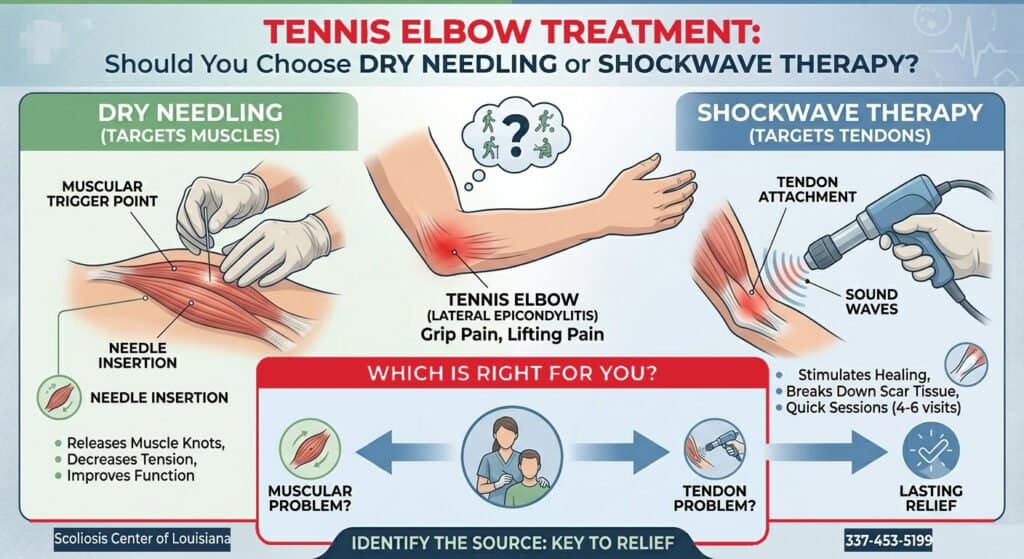
When Dry Needling May Help
Dry needling focuses primarily on muscle dysfunction.
Several muscles in the forearm can develop trigger points that contribute to elbow pain.
These muscles are responsible for:
* Wrist extension
* Grip strength
* Forearm stability
When trigger points develop, they may increase tension on already irritated tendons.
Dry needling may help:
- Reduce muscle tension
- Improve movement
- Improve grip comfort
- Address trigger points in the forearm
- Patients who have significant forearm tightness often respond well.
When Shockwave Therapy May Help
Shockwave therapy focuses more directly on chronic tendon injuries.
The treatment uses acoustic waves to stimulate healing responses within damaged tissue and can be tender.
Shockwave therapy is commonly used for:
- Chronic tennis elbow
- Tendinopathy
- Long-standing elbow pain
- Cases that haven’t improved with traditional care
- Research has shown encouraging results for chronic tendon conditions, including tennis elbow.
Which Treatment Is Better?
There isn’t a universal answer.
Some patients have primarily muscular problems.
Others have primarily tendon problems.
Many have both.
This is why a proper examination is so important.
Sometimes the Best Answer Is Both
This surprises many patients.
You don’t always have to choose one or the other.
Consider a patient with:
- Chronic tendon degeneration
- Tight forearm muscles
- Reduced grip strength
Shockwave therapy may address the tendon.
Dry needling may address the muscular component.
Together they may provide a more comprehensive treatment approach.
Other Treatment Options
Depending on the condition, treatment may also include:
Chiropractic care
Activity modification
Strengthening exercises
Mobility work
Ergonomic changes
Home exercises
The best results often come from addressing multiple contributing factors.
Frequently Asked Questions
* Is tennis elbow caused by inflammation?
Not always. Many chronic cases involve tendon degeneration rather than ongoing inflammation.
* Can dry needling help tennis elbow?
If muscle tension and trigger points contribute to symptoms, dry needling may be beneficial.
* If I tried dry needling and shockwave and it didn’t work?
I would suggest reading these articles that deal with each directly, dry needling didn’t work and shockwave didn’t work
* Can shockwave therapy help tennis elbow?
Shockwave therapy is commonly used for chronic tendon injuries, including tennis elbow.
* Which treatment works faster?
Results vary depending on the source of the problem and the severity of the condition.
* Can I receive both treatments?
Yes. Some patients benefit from combining dry needling and shockwave therapy.
Stop Guessing and Start Treating the Right Problem
Two patients can both have tennis elbow but require very different treatment plans.
One may need dry needling.
One may need shockwave therapy.
Many benefit from a combination of approaches.
At the Scoliosis Center of Louisiana, Dr. Justin Trosclair performs a thorough evaluation to identify the source of your elbow pain and determine which treatment options may be most appropriate.
Schedule Your Consultation
Scoliosis Center of Louisiana
Dr. Justin Trosclair, DC
📞 337-453-5199 call or text for an appointment
Serving Lafayette, Youngsville, Broussard, Scott, Carencro, and the greater Acadiana region.