
You probably already know your posture isn’t great.
You catch yourself hunched over a screen, head tilted forward, shoulders rounded. You straighten up for about 30 seconds, and then you drift right back. By the end of a workday, the base of your skull is aching, your upper traps feel like concrete, and there’s a specific spot between your shoulder blades that just won’t quit.
You stretch it. You roll it. Maybe someone in your life gives you a shoulder massage that feels amazing for about an hour. Then it’s back.
This isn’t a character flaw and it isn’t weakness. It’s physics — and it’s happening to an entire generation of people who spend their days in a posture the human body was never designed to hold for eight-plus hours at a stretch.
The problem is real. But the tool most people are using to fix it — stretching and surface massage — isn’t reaching the actual source.
The Physics of “Tech Neck”
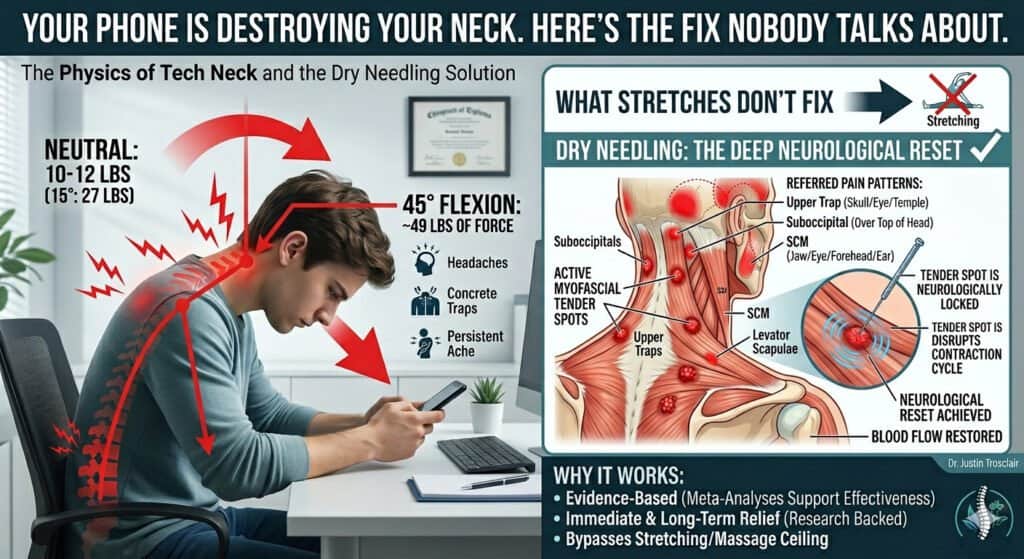
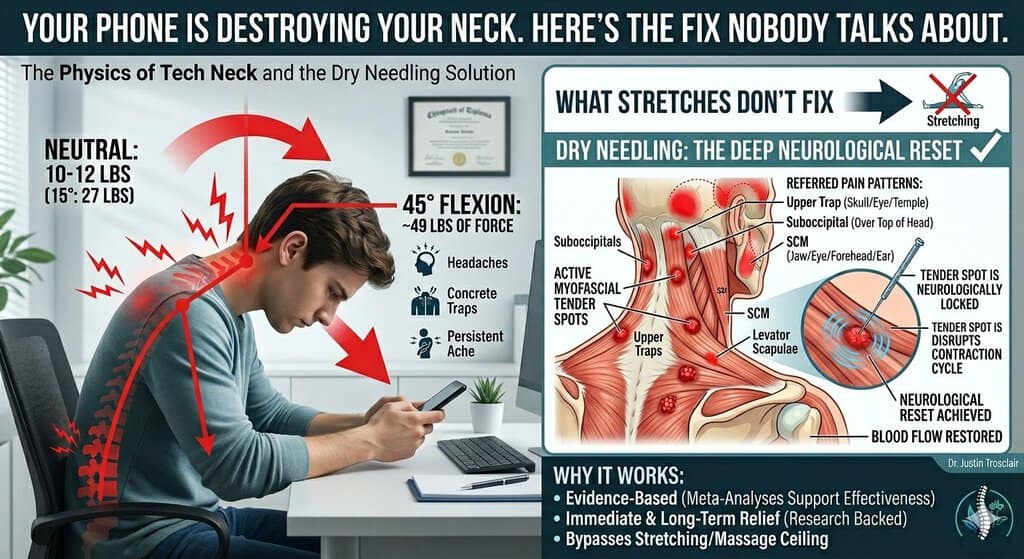
The average adult head weighs 10 to 12 pounds in neutral position. Move it 15 degrees forward and the effective load on the cervical spine jumps to about 27 pounds. At 30 degrees of forward flexion — roughly the position of looking at a phone in your lap — that load reaches 40 pounds. At 45 degrees, it’s closer to 49.
The muscles of the neck and upper back — the suboccipitals, the upper trapezius, the cervical paraspinals, the levator scapulae — spend hours every day under that abnormal load. They adapt the only way muscles can under chronic overload: they develop trigger points and tender spots.
Trigger points are tight, hyperirritable knots within a muscle fiber that lock the tissue in sustained contraction, restrict blood flow, accumulate metabolic waste, and generate persistent pain — both locally and in referred patterns at a distance from the knot itself. The upper trapezius famously refers pain up into the skull, behind the eye, and across the temple. The suboccipitals drive headache patterns that radiate over the top of the head. The sternocleidomastoid — the thick muscle running down the side of your neck — refers pain into the jaw, the eye, the forehead, and the ear.
Patients dealing with these patterns often chase the pain to the wrong location for months. The jaw treatment doesn’t fix the jaw pain because the jaw pain is coming from the neck. The sinus treatment doesn’t fix the face pressure because the pressure is from a trigger point, not sinuses.
What the Research Shows
Neck pain driven by myofascial trigger points is one of the best-researched applications of dry needling in musculoskeletal medicine, and the evidence is consistently favorable.
* A 2025 systematic review and meta-analysis published in Surgical Neurology International — analyzing 9 randomized controlled trials with 540 participants — found that dry needling significantly reduced pressure sensitivity and improved function in patients with chronic mechanical neck pain, as measured by both the pressure pain threshold and the Neck Disability Index. The reviewers concluded that dry needling shows genuine promise as a short-term intervention, outperforming control treatments on both pain and functional measures.
* A separate systematic review and meta-analysis that screened 662 studies and ultimately included 14 high-quality clinical trials found that dry needling reduced pain immediately after treatment and at short-term follow-up compared to sham treatment, placebo, or doing nothing. It also showed meaningful improvements in pain-related disability at short-term follow-up. Across all 14 included studies, improvements in cervical pain were reported — making this one of the more comprehensive looks at the evidence available.
* An updated systematic review specifically examining dry needling for trigger points associated with neck pain — drawing on 28 randomized controlled trials — confirmed that dry needling reduced pain immediately after treatment with a mean difference of -1.53, and at short-term follow-up with a mean difference of -2.31 compared to sham or placebo. It also found a meaningful improvement in pressure pain threshold of 55.48 kPa immediately post-treatment. In plain terms: the muscles became significantly less sensitive and reactive following dry needling, and that improvement held at follow-up.
* A 2025 systematic review published in Medicina compared deep versus superficial dry needling techniques for neck pain with trigger points across multiple randomized controlled trials. The finding that stands out for patients: there was no clinically meaningful difference in outcomes between the two approaches.
What that tells us is that the critical variable isn’t how deep the needle goes — it’s finding the right spot. Accurate trigger point / tender spots identification matters more than technique depth.
Why Your Stretches Aren’t Fixing It
Stretching is valuable. It addresses the tissue at the structural level, improves range of motion, and counters the shortening that sustained posture creates. It’s worth doing.
But here’s the ceiling it runs into: a trigger point is a neurologically driven phenomenon. The muscle fiber isn’t just mechanically tight — it’s locked by a sustained nerve signal that stretching cannot interrupt. You can lengthen the surrounding tissue all day, and the trigger point knot will contract right back to where it was when you stop.
Surface massage hits the same ceiling for the same reason. It increases circulation and temporarily suppresses trigger point and tender spot activity — which is why it feels good and provides temporary relief. But without directly disrupting the contraction cycle, the pattern reloads within hours.
Dry needling bypasses the surface entirely. The needle goes directly into the trigger point and tender spot, produces the local twitch response — the brief, involuntary muscle contraction that signals the neurological reset — and allows the tissue to release in a way that nothing applied from the outside can replicate.
What Treatment Looks Like
The assessment maps the pain pattern. Where does it start? Where does it travel? What makes it worse — screens, stress, sleeping position? Does it produce headaches? Jaw tension? Ear aching?
Palpation through the upper traps, cervical paraspinals, suboccipitals, and SCM identifies the taut bands and active trigger points. When pressure on a trigger point and tender spot recreates the patient’s familiar pain — including referred pain at a distance — the source is confirmed.
The needling takes 10 to 15 minutes. The muscles treated in the cervical and upper thoracic region are superficial enough that most patients report minimal sensation on needle entry. The twitch response — the deep, brief ache that signals the trigger point has been engaged — is the moment patients usually describe as “that’s exactly it.”
Most patients notice meaningful improvement within 24 to 48 hours. Significant reductions in tension, headache frequency, and referred pain are common after the first or second session. For patients who’ve been dealing with chronic neck tension for months or years, three to five sessions typically produce durable results when combined with postural correction and chiropractic care.
The Combination That Actually Works
Dry needling is most powerful in the neck when it’s paired with chiropractic adjustment of the cervical and thoracic joints, and with specific postural work to address the forward head position that’s driving the load in the first place.
The adjustment restores joint mechanics — the restricted segments in the cervical spine that chronic posture has jammed up. The dry needling resets the muscular layer — the trigger points and tender spots that the joint restriction helped create and that keep recreating the restriction. Neither alone is as effective as both together.
And then the postural work gives the tissue a fighting chance to stay better — because the load pattern that created the problem starts to change.
We compare dry needling to acupuncture here.
The Honest Reality About “Tech Neck”
The postural demands that caused this aren’t going away. Most people aren’t going to put down their phones or leave their desk jobs. That’s a real constraint.
But the tissue response to that load — the trigger points, the tender spots, the referred pain, the headaches, the shoulder tension — is genuinely treatable. You don’t have to accept that this is just how your neck feels now.
The pain isn’t permanent. It’s a response to a specific, identifiable tissue problem. And that problem has a direct, effective solution.
Dr. Justin Trosclair, D.C. offers dry needling as part of comprehensive chiropractic and spinal care in Lafayette, Louisiana. If chronic neck pain, upper trap tension, or tech-neck-related headaches have become part of your daily experience, call or text the clinic , schedule a consultation 1 337 453 5199 to discuss your specific situation.