
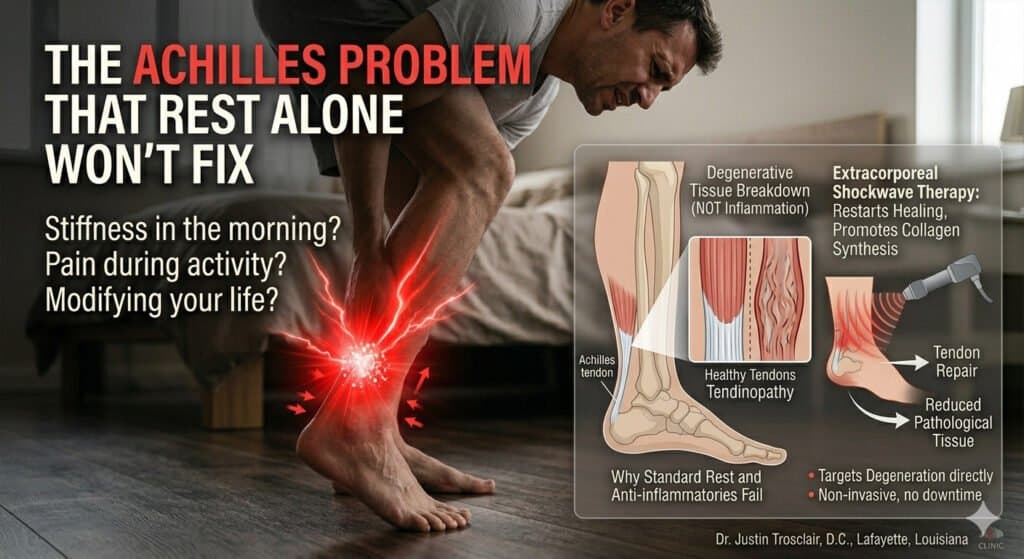
It starts as stiffness in the morning — that first trip from the bed to the bathroom where your heel feels like it’s 20 years older than the rest of you.
You loosen up after a few minutes. So you keep training. You figure it’s just tight. You stretch it more, maybe ice it after runs, maybe take a few days off. The stiffness becomes an ache. The ache becomes pain during activity. Eventually you start modifying — shorter distances, slower pace, different shoes — telling yourself it’ll calm down on its own.
Months later, it hasn’t calmed down.
This is Achilles tendinopathy. It’s one of the most common overuse conditions in active adults, it affects runners, weekend athletes, and people who simply stand on their feet all day — and it’s one of the most frequently mismanaged conditions in sports medicine, largely because the biology of what’s actually happening in the tendon is misunderstood.
Rest doesn’t fix it. Anti-inflammatories don’t fix it. And waiting it out usually just means dealing with it for longer.
Here’s what’s actually happening — and why shockwave therapy is now considered one of the most effective interventions available.
What’s Really Going On Inside the Tendon
The Achilles tendon is the thickest, strongest tendon in the body. It absorbs forces equivalent to 6 to 8 times your body weight with every running stride. Over time — particularly with repetitive loading, inadequate recovery, or sudden increases in training volume — the tendon develops a specific type of damage that doesn’t behave like a typical injury.
This is the core misunderstanding that causes Achilles problems to linger. The condition is called tendinopathy — not tendinitis. The -itis suffix implies acute inflammation. But research over the past two decades has consistently shown that chronic Achilles pain is characterized by a degenerative process, not primarily an inflammatory one. The collagen architecture of the tendon breaks down. Normal organized fibers are replaced by disorganized, thickened tissue. The tendon loses its mechanical resilience. And because the blood supply to the mid-portion of the Achilles is inherently limited, the normal healing response stalls.
The tendon can’t heal itself at the rate it’s being reloaded — and standard conservative care doesn’t change that equation. Rest reduces the load but doesn’t repair the tissue. Stretching and eccentric exercises help the tendon adapt over time but don’t directly address the degenerative process. Anti-inflammatories address the wrong target — there isn’t much inflammation to suppress.
The tissue needs something that can restart the healing response from the inside. That’s exactly what shockwave therapy does.
How Shockwave Therapy Changes the Biology
Extracorporeal shockwave therapy delivers focused acoustic energy into the degenerated tendon tissue through a handheld device applied to the skin. No needles. No incisions. No injections.
What those acoustic waves do inside the tissue is the key:
They restart the healing response. The shockwaves create controlled microtrauma in the degenerative tissue — essentially sending a biological signal that an injury requiring repair is present. This triggers neovascularization, the growth of new blood vessels in a tendon region that had become chronically underperfused. New blood supply is the raw material for real tissue repair.
They stimulate collagen synthesis. Shockwaves promote the production of new, organized collagen — which is what the tendon structure is actually made of and what needs to be rebuilt for it to function properly again.
They desensitize the local nerve endings. Over the course of treatment, shockwave therapy reduces the hypersensitivity of the pain receptors that have become chronically activated in the injured tissue. This is why pain relief with shockwave tends to be durable rather than temporary — it’s not just masking a signal, it’s changing the tissue environment that was generating the signal.
They break down pathological tissue. In cases where degenerative or calcific changes have occurred within the tendon, shockwave mechanically disrupts that abnormal tissue and allows the body to reabsorb and replace it.
What the Research Shows
There are multiple published studies on shockwave therapy for Achilles tendinopathy, and the honest summary is this: the evidence is genuinely positive, particularly for patients who have already tried rest and stretching without lasting relief.
A 2023 systematic review and meta-analysis published in the Journal of Chiropractic Medicine looked specifically at shockwave therapy used on its own — without any other treatment added — for Achilles tendinopathy. Reviewing the available randomized controlled trials, the researchers concluded that shockwave is an effective standalone option that reduces pain and improves function. That’s meaningful, because most studies test treatments in combination. This one confirmed shockwave earns its place even without layering other therapies on top.
A separate 2022 systematic review published in Cureus — which screened 283 published articles and analyzed 7 randomized controlled trials specifically on mid-portion Achilles tendinopathy — found consistent evidence across 4 of those trials that shockwave reduces pain and improves function. The reviewers also noted that combining shockwave with eccentric loading exercises produced even better results than shockwave alone, and concluded that shockwave is a safe and effective option, particularly for patients who want to avoid injections or surgery.
A 2024 retrospective review published in the Orthopaedic Journal of Sports Medicine followed patients with chronic Achilles tendinopathy — both mid-portion and insertional — after they completed a shockwave protocol. All patients in the study had already failed at least one round of physical therapy before receiving shockwave. The results showed significant improvements in pain and function, with meaningful gains maintained at follow-up. Patients with mid-portion tendinopathy responded particularly well.
One thing worth saying plainly: the research on shockwave for Achilles tendinopathy shows it works best when compared to doing nothing or sticking with standard conservative care. Head-to-head comparisons with aggressive eccentric exercise programs show more mixed results — which is actually useful information. If you’ve been doing the stretches and the loading exercises faithfully and still aren’t getting better, shockwave addresses a different layer of the problem that exercise alone can’t reach.
Mid-Portion vs. Insertional: Does It Matter?
Yes — and it’s worth knowing the difference.
Mid-portion Achilles tendinopathy occurs in the tendon itself, typically 2 to 6 centimeters above the heel bone. This is the most common type and has the strongest evidence base for shockwave therapy.
Insertional Achilles tendinopathy occurs at the point where the tendon attaches to the heel bone and often involves bone spurring or calcification at that attachment. It tends to be more persistent and can be more sensitive to certain exercises. Shockwave therapy addresses both types, and both show meaningful response — though insertional cases may require slightly different treatment parameters.
The clinical assessment determines which type you’re dealing with and guides the treatment approach.
Who Is a Good Candidate
Shockwave therapy for Achilles tendinopathy is most appropriate for:
Symptoms present for more than 6 weeks despite rest and standard conservative measures
Runners, hikers, or other athletes who’ve been unable to return to activity at previous levels
Active adults who’ve been told to “just rest it” but find that rest only provides temporary relief before the pain returns when activity resumes
Patients who want to avoid injections or have already tried them without lasting benefit
Those with imaging findings showing tendon thickening, degeneration, or calcification
It’s also appropriate for patients who’ve accepted a modified lifestyle around their Achilles — shorter walks, avoiding stairs, giving up running entirely — and assumed this is permanent. It often isn’t.
What Treatment Involves
A typical shockwave protocol for Achilles tendinopathy involves 3 to 5 sessions, spaced approximately one week apart. Each session takes about 15 minutes.
The acoustic device is applied directly over the affected tendon. You’ll feel a series of pulses — tapping with some intensity over the most symptomatic areas. There’s no anesthesia required and no recovery time afterward.
Many patients notice improvement beginning after the second or third session. The full effect often continues to develop in the 4 to 6 weeks following the final session as the tissue continues the repair process that shockwave therapy initiated. Some mild soreness in the 24 to 48 hours following a session is normal and indicates that the biological response has been activated.
The 3-Step Path Back to Running, Walking, and Living Without Modifying Your Day Around Your Heel
Step 1 — Get properly assessed. Confirm the diagnosis, identify whether the presentation is mid-portion or insertional, rule out any contraindications, and understand exactly what the tissue needs.
Step 2 — Complete the shockwave protocol. Three to five sessions targets the degenerative tissue directly, restarts the repair process, and begins the desensitization of the hypersensitive nerve endings driving the pain.
Step 3 — Reload progressively. As the tissue heals, a graded return to activity — with appropriate loading guidance — ensures the tendon rebuilds its mechanical resilience without being re-injured in the process.
The Achilles you’ve been babying doesn’t have to stay that way. The tissue can heal. The pain can resolve. And the modification of your activity level, your shoes, and your morning routine doesn’t have to be permanent. Curious about if you should do dry needling vs shockwave, then read this article
Dr. Justin Trosclair, D.C. offers shockwave therapy as part of comprehensive musculoskeletal care in Lafayette, Louisiana. If Achilles pain has been limiting your activity and standard conservative treatment hasn’t delivered lasting results, call the clinic 1 337 453 5199 or schedule a consultation to find out whether shockwave therapy is the right next step.