
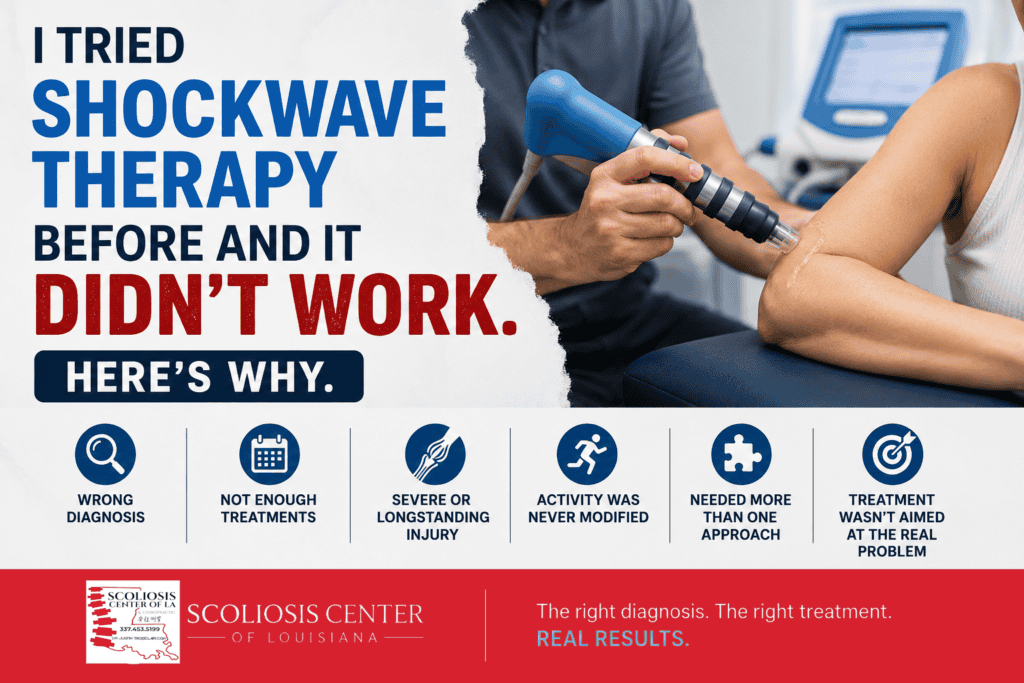
Before You Write Off Shockwave Therapy, Let’s Talk About What Happened.
You spent the money.
You showed up for the treatments.
You were hopeful.
Then weeks later, you found yourself thinking:
“Shockwave therapy didn’t work for me.”
At the Scoliosis Center of Louisiana, we occasionally meet patients who have had shockwave therapy before but were disappointed with the results.
The surprising part?
Many times the issue isn’t that shockwave therapy doesn’t work.
The issue is that one important piece of the puzzle was missing.
Let’s look at some common reasons why treatment may not have delivered the outcome you expected.
Reason #1: The Diagnosis Wasn’t Correct
Shockwave therapy is most commonly used for chronic tendon and soft tissue injuries.
* Examples include:
Plantar fasciitis
Achilles tendinopathy
Tennis elbow
Jumper’s knee
Certain types of chronic shoulder pain
Greater trochanteric pain syndrome
If the real source of pain is coming from:
Arthritis
A nerve problem
A disc injury
A muscle trigger point
Then shockwave may not be the ideal treatment.
Even the best treatment struggles when applied to the wrong condition.
Reason #2: You Didn’t Receive Enough Treatments
Many chronic injuries have existed for months or even years.
They don’t always respond after a single session.
A common treatment plan may involve multiple visits spread over several weeks.
Some patients improve quickly.
Others need more time.
The severity of the injury often matters.
Reason #3: The Tissue Was Extremely Degenerated
Not all tendon injuries are equal.
Some patients seek care within a few months.
Others wait years.
The longer a tendon has been injured, the more difficult recovery can become.
Shockwave therapy may still help, but progress can take longer than expected.
Reason #4: Activity Was Never Modified
This is one of the most common problems.
Imagine trying to repair a crack in a sidewalk while someone repeatedly drives over it.
Healing becomes difficult.
Many tendon injuries require temporary modifications to:
* Running
* Jumping
* Lifting
* Repetitive work activities
The goal isn’t complete rest.
The goal is creating an environment where healing can occur.
Reason #5: The Injury Needed More Than One Treatment Approach
Shockwave therapy is often one piece of a larger treatment plan.
Depending on the condition, other recommendations may include:
* Strengthening exercises
* Mobility work
* Chiropractic care
* Dry Needling
* Footwear modifications
* Activity changes
* Home exercises
Injections but not really recommended by me
The most successful outcomes often come from combining therapies rather than relying on a single solution.
Reason #6: Expectations Were Unrealistic
Many advertisements make healthcare sound simple.
Reality is more complicated.
Shockwave therapy can be highly effective for the right condition, but it does not instantly reverse years of tissue damage.
The goal is gradual improvement.
Patients often notice:
* Less pain
* Better function
* Improved activity tolerance
* Faster recovery after exercise
These improvements typically happen over time.
Reason #7: The Problem Wasn’t Actually a Tendon
This may be the biggest reason of all.
Many conditions look similar.
For example:
* Heel pain may not always be plantar fasciitis.
* Hip pain may not always come from the hip tendon.
* Shoulder pain may not always be a tendon injury.
A thorough evaluation is often the difference between choosing the right treatment and guessing.
Frequently Asked Questions
* Does shockwave therapy work for everyone?
No treatment works for every patient or every condition.
* Should I try shockwave therapy again if it didn’t help before?
Possibly. If the diagnosis or treatment plan was incomplete, a second evaluation may reveal a different approach.
* How many treatments are usually needed?
The answer depends on the condition, severity, and how long symptoms have been present.
* Does shockwave therapy hurt?
Most patients describe the treatment as uncomfortable but very tolerable.
* What if my pain is coming from muscles instead of tendons?
In some cases, dry needling, chiropractic care, exercise, or other therapies may be more appropriate.
A Treatment Can Be Good and Still Be the Wrong Treatment
* One of the biggest mistakes patients make is assuming:
“The treatment didn’t work, so it must be a bad treatment.”
* Sometimes the treatment was simply aimed at the wrong target.
The key is identifying the true source of pain before deciding what treatment makes the most sense.
At the Scoliosis Center of Louisiana, Dr. Justin Trosclair performs a detailed examination to determine whether shockwave therapy, dry needling, chiropractic care, or another approach may be most appropriate for your condition.
Scoliosis Center of Louisiana
Dr. Justin Trosclair, DC
📞 337-453-5199 Call or Text Today to get scheduled
Serving Lafayette, Youngsville, Broussard, Scott, Carencro, and the greater Acadiana region.
If you’ve tried shockwave therapy before and didn’t get the results you hoped for, let’s find out why.
Schedule your consultation today.