
You want to keep training. You want to stay in the game. But pain keeps showing up every time you run, jump, throw, lift, or compete.
Athletes often ask:
Should I choose shockwave therapy or dry needling?
The answer depends on what’s causing your pain.
At the Scoliosis Center of Louisiana, we use both treatments, but they solve different problems.
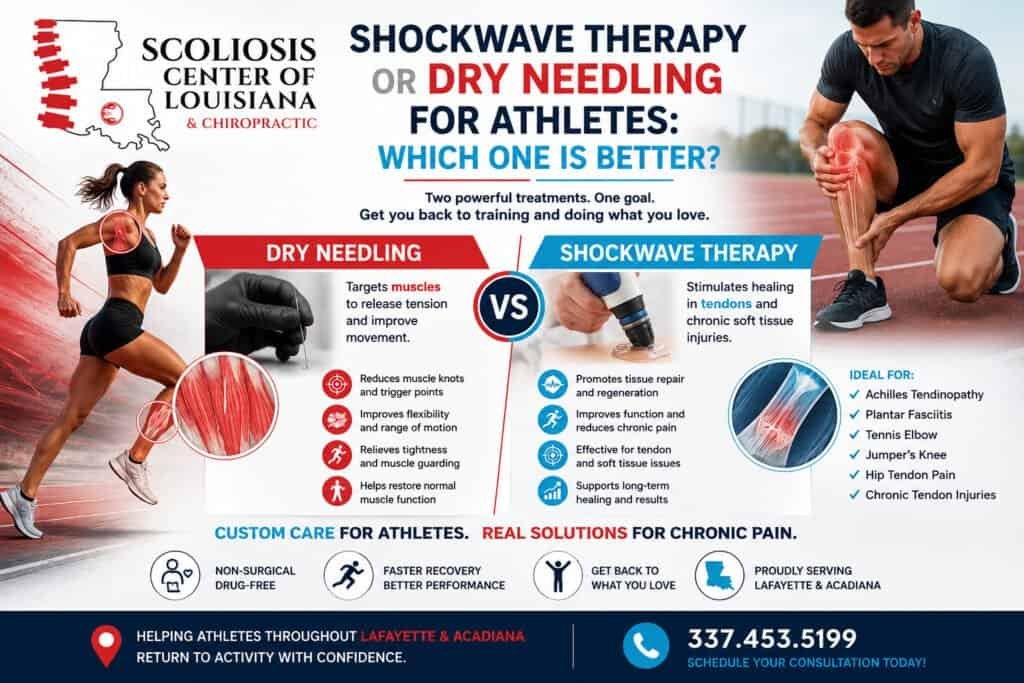
What Does Dry Needling Do?
Dry needling uses a thin needle to target:
- Trigger points
- Tight muscles
- Muscle knots
- Muscle guarding
The goal is to improve muscle function and reduce tension.
Athletes commonly seek dry needling for:
- Tight calves
Hamstring problems
Piriformis syndrome
Shoulder tightness
Neck pain
Back pain
What Does Shockwave Therapy Do?
Shockwave therapy is designed more for chronic tendon and soft tissue injuries.
Common examples include:
- Achilles tendinopathy
Plantar fasciitis
Tennis elbow
Jumper’s knee
Hip tendon pain
Rather than targeting muscle knots, shockwave focuses on injured tissue that may not be healing properly.
When Athletes Usually Benefit From Dry Needling
Dry needling may be a better choice if:
- Muscles constantly feel tight
Range of motion is restricted
You have recurring muscle spasms
Symptoms improve with massage but quickly return
When Athletes Usually Benefit From Shockwave Therapy
Shockwave therapy may be better if:
- Pain has lasted months
The pain is located at a tendon attachment
Running or jumping aggravates symptoms
Previous therapy has failed
Can You Combine Them?
Absolutely.
Many athletes benefit from both.
For example: A runner with Achilles tendinopathy may have: Damaged tendon tissue or Tight calf muscles
Shockwave may target the tendon while dry needling addresses muscle tension. Both may or may not be painful in the exact area of pain.
Common Athletic Conditions
Runner’s Knee
Depending on the cause, either treatment may be helpful.
Jumper’s Knee
Shockwave therapy is often considered for chronic patellar tendon problems.
Hamstring Tightness
Dry needling is commonly used to reduce muscle tension and improve flexibility.
Plantar Fasciitis
Shockwave therapy is frequently chosen when symptoms become chronic.
Frequently Asked Questions
Which treatment works faster?
It depends on the source of pain.
Muscle problems often improve quickly with dry needling.
Chronic tendon injuries typically require a series of shockwave treatments.
Can athletes train after treatment?
Usually yes, although modifications may be recommended.
Which treatment hurts more?
Most athletes tolerate both very well.
Can both treatments be performed together?
Yes.
Many treatment plans combine both approaches.
Ready to Get Back to Training?
If pain is limiting your performance, let’s identify the real source of the problem and choose the right treatment.
You might be interested in learning about cortisone injections too.
Scoliosis Center of Louisiana
Dr. Justin Trosclair, DC
📞 337-453-5199 Call or Text Today to get scheduled
Helping athletes in Lafayette and throughout Acadiana return to activity with confidence.
Schedule your consultation today.