
Pain Shooting Down Your Leg Doesn’t Always Mean Sciatica
You feel pain in your buttock.
Maybe it travels down your leg.
Sometimes it burns.
Sometimes it tingles.
Sometimes sitting makes it worse.
Most people immediately assume:
“I have sciatica.”
Maybe.
But not always.
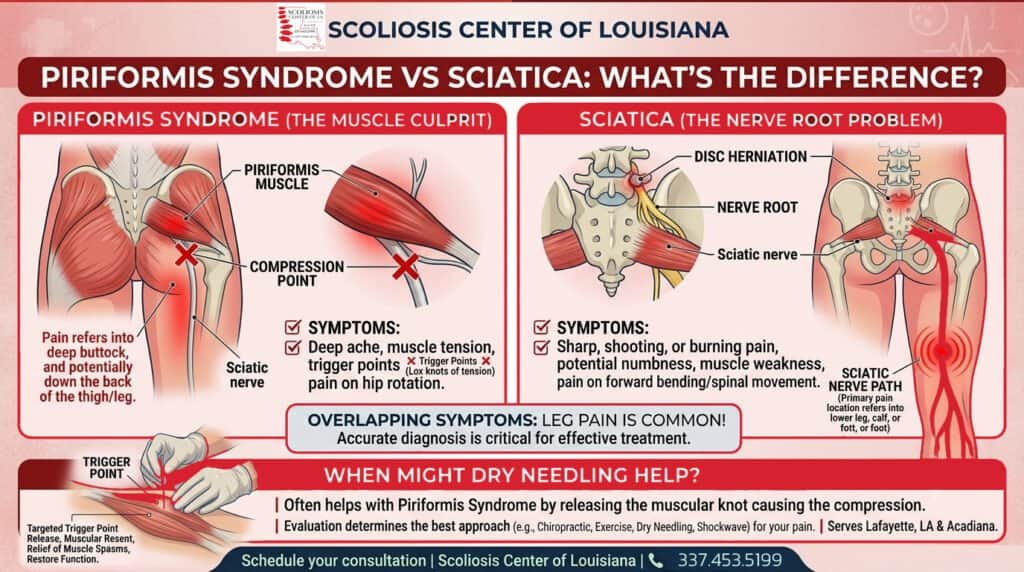
One condition that is frequently mistaken for sciatica is called Piriformis Syndrome.
The symptoms can look very similar, but the source of the problem is completely different.
At the Scoliosis Center of Louisiana, one of the most important parts of evaluating leg pain is determining whether the problem is coming from the lower back, the sciatic nerve itself, or the muscles surrounding it.
What Is Sciatica?
Sciatica is not actually a diagnosis.
It’s a description of symptoms caused by irritation of the sciatic nerve.
The sciatic nerve is the largest nerve in the body.
It begins in the lower back and travels through the buttock and down the leg.
When the nerve becomes irritated, symptoms may include:
- Common causes of sciatica include:
* Disc bulges
* Disc herniations
* Spinal stenosis
* Degenerative changes in the spine
In these cases, the problem typically begins in the lower back and it comes and goes.
Common causes of sciatica include:
Disc bulges
Disc herniations
Spinal stenosis
Degenerative changes in the spine
In these cases, the problem typically begins in the lower back and it comes and goes.
What Is Piriformis Syndrome?
The piriformis is a small muscle deep in the buttock.
Its job is to help rotate the hip and stabilize movement.
The sciatic nerve (dry needling treatment for sciatica) runs very close to this muscle.
In some people, the nerve even passes directly through the muscle.
When the piriformis becomes tight, irritated, or develops trigger points, it can place pressure on the nearby sciatic nerve.
This can create symptoms that closely resemble sciatica.
Symptoms of Piriformis Syndrome
Common symptoms include:
- Deep buttock pain
- Pain while sitting
- Pain that travels down the leg
- Tightness in the hip
- Pain when climbing stairs
- Pain after prolonged driving
Many patients point directly to the center of the buttock when describing their symptoms.
How Are They Different?
Sciatica
Usually originates from the lower back. Often associated with:
- Back pain
- Disc problems
- Numbness
- Weakness
- Symptoms below the knee
Piriformis Syndrome
Usually originates in the buttock. Often associated with:
- Buttock pain
- Hip tightness
- Pain while sitting
- Tenderness over the piriformis muscle
- Trigger points
Both conditions may create similar leg symptoms, but both can be resolved.
That’s why a proper examination matters.
Why Diagnosis Is Important
Treatments that help piriformis syndrome may not be appropriate for disc-related sciatica.
Likewise, treatments aimed at the spine may not fully resolve symptoms coming from a dysfunctional piriformis muscle.
Choosing the correct treatment starts with identifying the true source of the problem.
How Dry Needling May Help
When trigger points and muscle tightness contribute to symptoms, dry needling may be beneficial.
Dry needling is designed to target:
- Trigger points
- Tight muscle bands
- Muscle dysfunction
- Restricted movement
Many patients with piriformis-related pain report improvement in mobility and reduced muscle tension after treatment.
Other Treatment Options
Depending on the diagnosis, treatment may include:
- Dry needling
- Chiropractic care
- Stretching
- Strengthening exercises
- Activity modification
- Mobility training
Every patient is different.
That’s why treatment should be individualized.
Frequently Asked Questions
* Can piriformis syndrome cause pain down the leg?
Yes. Because the sciatic nerve runs near the piriformis muscle, irritation can cause symptoms that travel down the leg.
* Is piriformis syndrome the same as sciatica?
No. Piriformis syndrome is one possible cause of sciatic nerve irritation.
* Can an MRI diagnose piriformis syndrome?
Piriformis syndrome is often diagnosed through history, examination findings, and ruling out other causes.
* Can dry needling help piriformis syndrome?
When muscle tension and trigger points are contributing factors, dry needling may be helpful.
How do I know which condition I have?
A proper evaluation is the best way to determine whether symptoms are originating from the spine, piriformis muscle, or another source.
Don’t Guess at the Source of Your Leg Pain
Sciatica and piriformis syndrome can feel remarkably similar.
But treating the wrong problem often leads to frustration and delayed recovery.
At the Scoliosis Center of Louisiana, Dr. Justin Trosclair performs a thorough evaluation to identify the true source of your symptoms and recommend the most appropriate treatment options.
Schedule Your Consultation
Scoliosis Center of Louisiana
Dr. Justin Trosclair, DC
📞337-453-5199 call or text
Serving Lafayette, Youngsville, Broussard, Scott, Carencro, and the greater Acadiana region.