
That First Step Out of Bed Isn’t Supposed to Hurt
You wake up.
You swing your legs over the side of the bed.
Your foot hits the floor.
Then comes the sharp pain.
For many people in Lafayette and throughout Acadiana, that first painful step is what finally sends them searching Google for answers.
The most common cause?
Plantar fasciitis.
Despite the name, plantar fasciitis often isn’t a true inflammatory condition anymore by the time most people seek treatment.
In many cases, it has become a chronic tissue problem that simply isn’t healing properly.
What Is the Plantar Fascia?
The plantar fascia is a thick band of connective tissue that runs along the bottom of your foot.
It helps:
- Support your arch
- Absorb shock
- Transfer force when walking and running
Every step you take places stress on this tissue.
Over time, that stress can exceed the tissue’s ability to recover.
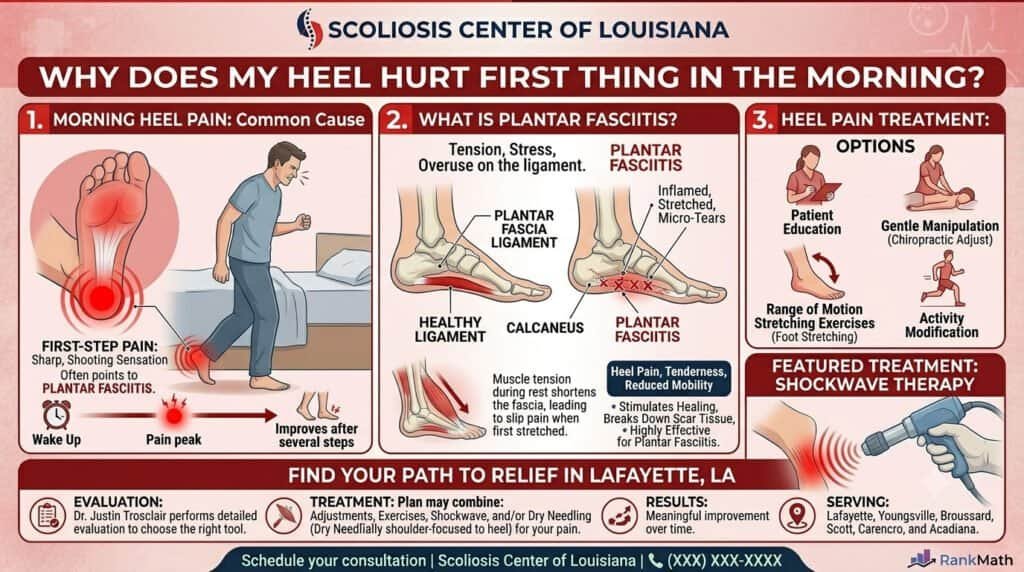
Why Is the Pain Worse in the Morning?
This is one of the classic signs of plantar fasciitis.
While you sleep, the plantar fascia shortens slightly.
When you take your first few steps, the tissue suddenly stretches again.
That creates the sharp pain many patients describe.
Interestingly, the pain often improves after walking around for a few minutes.
Unfortunately, that doesn’t mean the problem is gone.
It simply means the tissue has warmed up.
Common Symptoms of Plantar Fasciitis
You may have plantar fasciitis if you experience:
- Sharp heel pain in the morning
- Pain after sitting for long periods
- Pain after exercise
- Tenderness near the heel bone
- Pain that improves as you move around
- Many patients notice symptoms for months before seeking care.
Why Rest Alone Often Doesn’t Fix It
One of the biggest misconceptions about plantar fasciitis is that it simply needs more rest.
For acute injuries, rest can be helpful.
For chronic plantar fasciitis, the tissue often becomes degenerative rather than inflammatory.
That’s why many patients find themselves stuck in a cycle:
- Rest
- Feel better
- Return to activity
- Pain returns Again and again.
Common Treatments for Plantar Fasciitis
Treatment may include: - Stretching
- Footwear changes
- Orthotics
- Activity modification
- Chiropractic care
- Strengthening exercises
- Shockwave therapy
The right treatment depends on the severity and duration of symptoms.
How Shockwave Therapy May Help
Shockwave therapy uses acoustic waves to stimulate biological healing responses within damaged tissue.
Research suggests shockwave therapy may help:
- Reduce pain
- Improve function
- Stimulate tissue healing
- Improve blood flow
It is commonly used for chronic plantar fasciitis that has not responded to traditional approaches.
One reason patients like shockwave therapy is that it is non-surgical and does not involve injections.
Could It Be Something Else?
Not every case of heel pain is plantar fasciitis.
Other possibilities include:
- Nerve irritation
- Stress fractures
- Fat pad syndrome
- Arthritis
- Achilles tendon problems
This is why a proper evaluation matters.
Frequently Asked Questions
* Is plantar fasciitis permanent?
No. Most people improve with appropriate treatment and activity management.
* How long does plantar fasciitis last?
Some cases improve within weeks. Others may persist for months or longer.
* Is walking good for plantar fasciitis?
Moderate activity is often beneficial, but excessive activity can aggravate symptoms.
* Do cortisone injections fix plantar fasciitis?
Cortisone may temporarily reduce pain, but it does not necessarily address the underlying tissue quality.
* Does shockwave therapy hurt?
Most patients tolerate treatment very well. Some mild discomfort may occur during treatment.
Don’t Ignore Morning Heel Pain
Your body is trying to tell you something.
The sooner the problem is identified, the easier it may be to prevent months of frustration.
At the Scoliosis Center of Louisiana, Dr. Justin Trosclair evaluates heel pain and helps patients determine whether shockwave therapy, chiropractic care, exercise, or another approach may be appropriate.
Schedule Your Consultation
Scoliosis Center of Louisiana
Dr. Justin Trosclair, DC
📞 337-453-5199 call or text
Serving Lafayette, Youngsville, Broussard, Scott, Carencro, and the greater Acadiana region.