
You woke up one morning and your shoulder just… didn’t move right. Maybe it started with a dull ache. Maybe you noticed you couldn’t reach your seatbelt anymore. Or brush your hair. Or grab something off the top shelf. Then it got worse. Now even simple things — putting on a jacket, rolling over in bed, reaching for your phone — feel like someone is yanking on your arm from the wrong direction. If that sounds familiar, you may have what’s called frozen shoulder — or adhesive capsulitis. And if nobody has given you a real plan to get better, this article is for you.
What Is Frozen Shoulder, Really?
Your shoulder joint is surrounded by a capsule — a thin sleeve of tissue that holds everything in place and lets your arm move in every direction. It’s what makes the shoulder the most flexible joint in your body.
When you have frozen shoulder, that capsule gets inflamed, then thickened, then tight. It literally shrinks down and stiffens up around the joint.
The result? Pain. Stiffness. And a shoulder that doesn’t move the way it should.
Frozen shoulder tends to go through three stages:
Stage 1 — The Freezing Stage: This is the painful phase. The shoulder aches constantly. Movement hurts more and more. This can last anywhere from 6 weeks to 9 months.
Stage 2 — The Frozen Stage: The sharp pain may ease up a little, but now the shoulder is really stiff. Moving it far in any direction hits a hard wall. This stage can last 4 to 6 months.
Stage 3 — The Thawing Stage: Slowly, movement starts to come back. This stage can take 6 months to 2 years.
Add it all up and frozen shoulder can last anywhere from one to three years if you just wait it out.
Nobody has time for that.
Why Does Frozen Shoulder Happen?
Sometimes there’s a clear trigger — a minor injury, a surgery, or even just a period of not using your arm much (like when you’re recovering from something else). Women are more likely to develop it than men, and it’s most common between ages 40 and 60.
People with diabetes are significantly more at risk. Research published in the Journal of Rheumatology found that individuals with diabetes are 3 to 5 times more likely to develop frozen shoulder compared to the general population (Bridgman, 1972, Journal of Rheumatology).
Some researchers now believe high blood sugar affects the connective tissue in ways that make the shoulder capsule more prone to stiffening.
But often, there’s no obvious cause at all. It just happens.
What makes it worse? When the shoulder hurts, you naturally protect it. You stop moving it. And that limited movement feeds the stiffening. The less you move, the more it freezes. It becomes a cycle.
Where Dry Needling Comes In
Here’s something most people don’t know about frozen shoulder: even though the joint capsule is the real problem, the muscles around the shoulder often become a huge part of why it hurts so much.
When your shoulder joint can’t move freely, the muscles around it go into overdrive trying to protect it. They get tight. They develop what are called trigger points — tight, knotted spots inside the muscle that can cause pain right there or refer pain somewhere else.
The rotator cuff muscles, the muscles across the upper back, the front of the chest, and even the muscles along the neck can all develop these tight, painful spots when frozen shoulder sets in.
Those trigger points / tender spots often become their own source of pain — completely separate from what’s happening inside the joint itself. They also restrict movement even further.
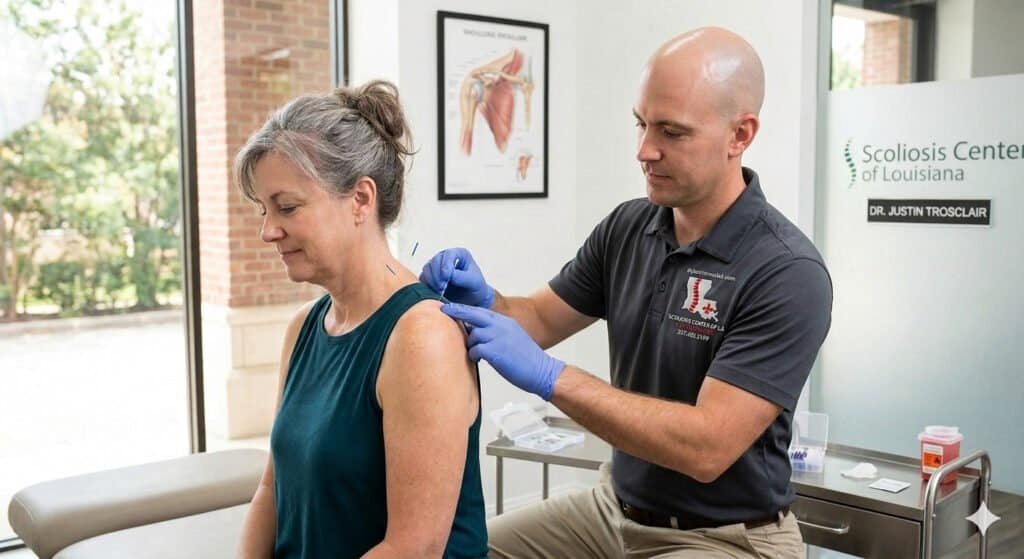
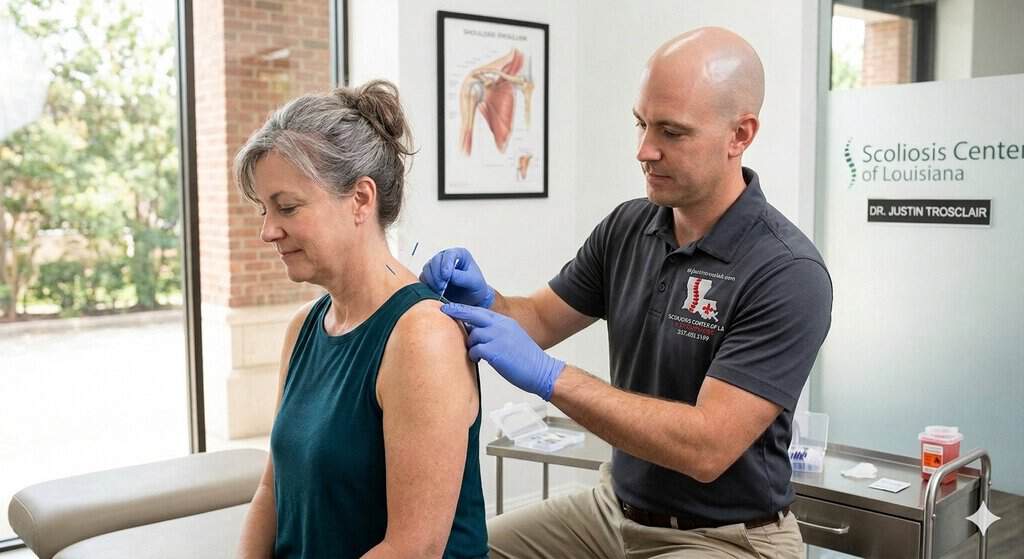
Dry needling compared to shockwave therapy, is a treatment that targets those trigger points directly.
A thin needle — much smaller (10x or more) than the kind used for injections — is inserted into the tender spot. This causes the tight muscle fibers to release. Blood flow increases. The muscle relaxes.
It doesn’t feel like much. Some patients describe a brief twitch or a dull ache when the needle hits the right spot. That twitch is actually a good sign — it means the needle found the trigger point, and the muscle is releasing.
What Does the Research Say?
* A randomized controlled trial published in the Journal of Bodywork and Movement Therapies looked at patients with adhesive capsulitis and found that dry needling combined with physical rehabilitation produced significantly greater improvements in pain and shoulder range of motion compared to rehabilitation alone (Kavadar et al., 2015, JBMT, n=50).
* Another study in Acupuncture in Medicine found that patients with frozen shoulder who received dry needling showed meaningful reductions in pain scores and reported faster return to functional movement compared to those who didn’t receive the treatment (Itoh et al., 2008, Acupuncture in Medicine).
The research isn’t saying dry needling alone cures frozen shoulder — it’s a multi-layered condition that benefits from a comprehensive approach. But what the evidence does show is that addressing the muscle component of frozen shoulder through dry needling meaningfully speeds up recovery and reduces the severity of the experience.
What Dry Needling for Frozen Shoulder Actually Looks Like
The process starts with a thorough evaluation. Not every shoulder pain is the same, and a good clinician needs to understand where you are in the stages of frozen shoulder before deciding how to treat it.
Dry needling for frozen shoulder typically targets:
- The rotator cuff muscles (supraspinatus, infraspinatus, subscapularis, teres minor) — these often become overloaded and full of trigger points
- The upper trapezius and neck muscles, which tighten in response to guarding the shoulder
- The pectoralis minor in the front of the chest, which can pull the shoulder forward and limit external rotation
- Sometimes muscles of the upper arm, depending on where your movement is most restricted
- Sessions are usually 10–20 minutes. Most patients start to notice improvement in range of motion within the first 2–3 visits. Pain reduction often follows.
- This is usually combined with gentle range-of-motion work to help the shoulder reclaim the movement that’s been unlocked. The two together are more powerful than either one alone
You Shouldn’t Have to Wait Two Years to Get Your Shoulder Back
Frozen shoulder is miserable. It robs you of sleep. It makes getting dressed feel like a workout. It takes the things you used to do without thinking — reaching, lifting, carrying — and turns them into painful reminders of what you can’t do right now.
Here’s what most patients are told: “Just wait. It’ll go away on its own.”
And technically, for many people, it does eventually. But two years is a long time to be in pain and limited. And there’s strong evidence that getting the right treatment earlier shortens the duration significantly.
You don’t have to just wait this out.
A Plan That Actually Makes Sense
At the Scoliosis Center of Louisiana, Dr. Justin Trosclair has helped patients across Louisiana and surrounding states break through the frozen shoulder cycle using dry needling as part of a complete treatment approach.
Here’s how it works:
Step 1 — Find the real picture. Dr. Trosclair evaluates your specific range of motion restrictions, identifies the muscles that are contributing to your pain, and determines where you are in the stages of frozen shoulder.
Step 2 — Target the muscle barriers. Dry needling sessions directly address the trigger points / tender spots keeping your shoulder locked up, while coordinated movement work helps the joint reclaim its mobility.
Step 3 — Keep tracking progress. Every visit is measured. You’ll see your range of motion improve visit by visit, which keeps you motivated and tells Dr. Trosclair when to adjust the plan.
Ready to Move Again?
If you’ve been dealing with frozen shoulder — or even just that nagging shoulder pain that’s getting worse, not better — don’t wait another year to find out if this works.
Call Dr. Justin Trosclair at the Scoliosis Center of Louisiana today: 337 453-5199 Call or Text Today to get scheduled
Your shoulder was designed to move freely. Let’s get it back there.
References:
Bridgman J. F. (1972). Periarthritis of the shoulder and diabetes mellitus. Annals of the Rheumatic Diseases, 31(1), 69–71.
Clinical Trials
Kavadar G., Demircioglu D. T., Oner S. Y., & Elmali M. K. (2015). Effectiveness of low-level laser therapy in the management of periarthritis of the shoulder: a randomized placebo-controlled trial. Journal of Bodywork and Movement Therapies, 19(3), 487–494.
Itoh K., Katsumi Y., & Kitakoji H. (2008). A pilot study on using acupuncture and transcutaneous electrical nerve stimulation to treat shoulder pain. Acupuncture in Medicine, 26(1), 23–28.