
Your Knee Pain Isn’t Going Away Because It’s Not a “Knee Problem”
You rested.
You iced it.
Maybe you wore a brace.
You even stopped exercising for a while.
Yet every time you jump, run, squat, climb stairs, or get back into sports, the pain comes back.
If this sounds familiar, you may have a condition called patellar tendinopathy, often known as jumper’s knee.
At the Scoliosis Center of Louisiana, Dr. Justin Trosclair helps active adults and athletes in Lafayette find solutions for chronic tendon pain that won’t seem to heal on its own.
What Is Jumper’s Knee?
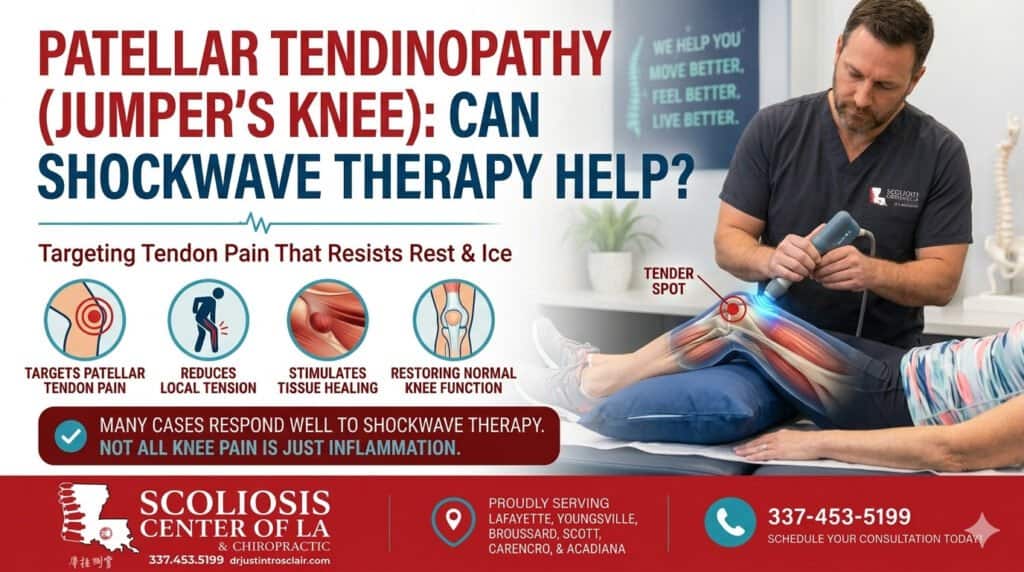
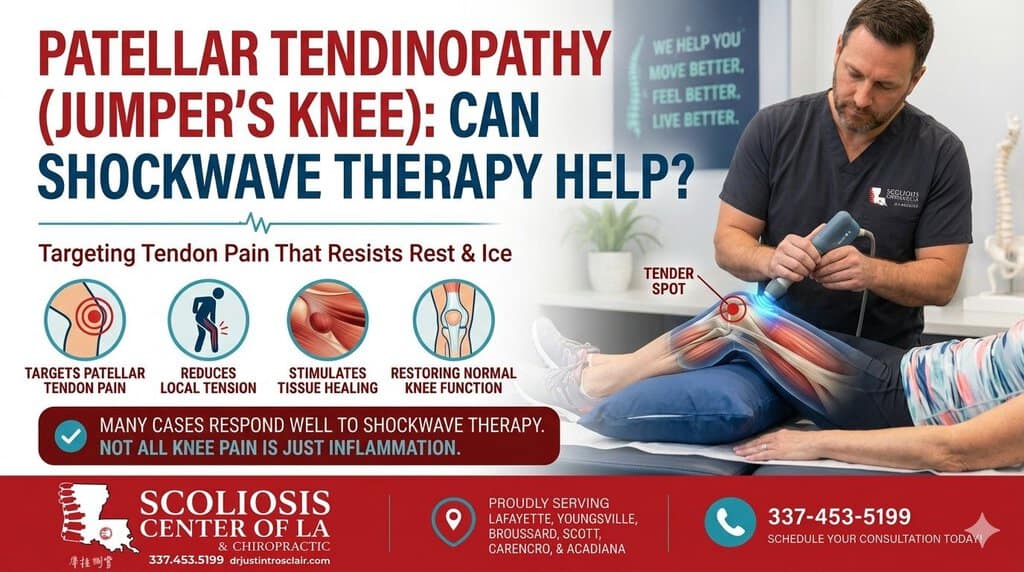
Patellar tendinopathy is irritation and degeneration of the patellar tendon.
This tendon connects your kneecap (patella) to your shin bone.
It helps you:
Jump
Sprint
Squat
Climb stairs
Change directions
Over time, repetitive stress can exceed the tendon’s ability to recover.
Instead of healing properly, the tendon becomes irritated and painful.
Common Symptoms
You may have jumper’s knee if you notice:
- * Pain just below the kneecap
* Pain during jumping
* Pain after sports
* Stiffness after sitting
* Pain during squats
* Tenderness below the kneecap
Many athletes continue training for months before seeking help.
Unfortunately, the condition often becomes more stubborn over time.
Why Rest Often Doesn’t Work
One of the biggest misconceptions is that jumper’s knee is simply inflammation.
Research suggests many chronic tendon injuries involve tissue degeneration rather than ongoing inflammation.
This explains why:
* Rest helps temporarily
* Anti-inflammatory medications only partially help
* Symptoms return once activity resumes
* The tendon often needs help restarting the healing process.
How Shockwave Therapy Works
Shockwave therapy uses acoustic pressure waves delivered through the skin.
The goal is to stimulate the body’s healing response.
Research has shown shockwave therapy may help:
- Improve blood flow
- Stimulate tissue repair
- Reduce pain
- Improve function
- Unlike injections, shockwave therapy is non-surgical and drug-free and in most cases only mild discomfort to receive.
Who Is Most Likely to Develop Jumper’s Knee?
We commonly see this condition in:
Basketball players
Volleyball players
Runners
CrossFit athletes
Soccer players
Pickleball players
Even active adults can develop jumper’s knee from repetitive exercise.
What Else Should Be Done?
Shockwave therapy works best when combined with proper rehabilitation.
Treatment may include:
- Activity modification
- Strengthening exercises
- Mobility work
- Biomechanical evaluation
- Chiropractic care when appropriate
The goal is not just reducing pain.
The goal is helping the tendon tolerate load again.
You don’t want injections do you?
Frequently Asked Questions
* Is shockwave therapy painful?
Most patients describe it as uncomfortable but very tolerable.
* How many treatments are needed?
Many patients receive 4-6 treatments depending on severity.
* Can I continue exercising?
Usually yes, but modifications may be recommended.
* Is surgery necessary?
Most cases improve without surgery.
* How long does recovery take?
Recovery varies depending on how long symptoms have been present.
Ready to Get Back in the Game?
If knee pain is keeping you from training, competing, or staying active, we may be able to help.
Scoliosis Center of Louisiana
Dr. Justin Trosclair, DC
📞 337-453-5199 Call or Text Today to get scheduled
Serving Lafayette, Youngsville, Broussard, Scott, Carencro, and the greater Acadiana area.
Schedule your consultation today.