
The pain woke you up again.
Not a dull ache — a sharp, catching pain when you rolled over in the middle of the night. Reaching into the back seat of your car. Lifting your arm above your head to grab something off a shelf. There’s a specific range of motion your shoulder doesn’t like, and when you move through it, it lets you know.
Your doctor probably told you there’s calcium in the rotator cuff. Maybe it showed up on an X-ray, maybe ultrasound. Calcific tendinitis. And the conversation that followed likely went one of a few ways: take anti-inflammatories, consider a cortisone injection, or wait and see if it resorbs on its own.
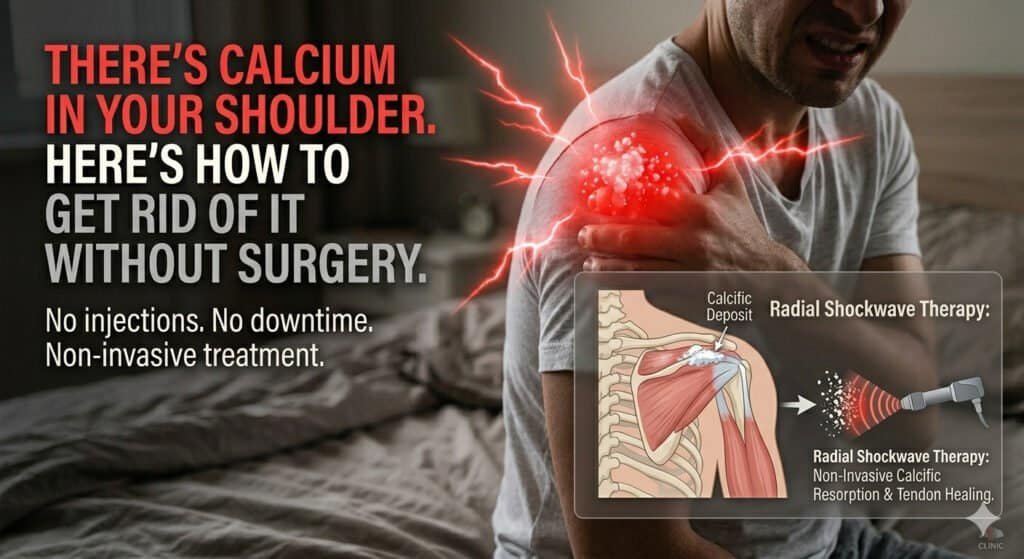
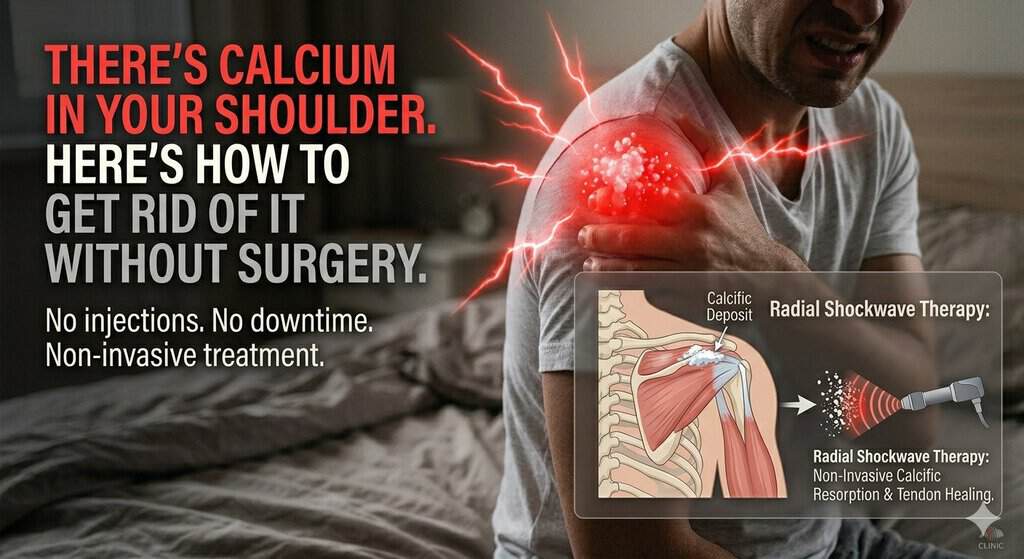
What may not have come up: there’s an evidence-based, non-invasive treatment that has been shown to reduce pain, improve shoulder function, and — in a significant percentage of cases — cause the calcium deposit itself to be reabsorbed by the body. No injection into the joint. No surgery. No extended downtime.
It’s shockwave therapy. And for calcific shoulder tendinitis specifically, the evidence behind it is some of the strongest in the entire field of musculoskeletal care.
What Calcific Tendinitis Actually Is
The rotator cuff is a group of four muscles and their tendons that stabilize the shoulder joint and control arm movement. Calcific tendinitis occurs when calcium phosphate crystals deposit within the tendon tissue — most commonly in the supraspinatus tendon, which sits directly under the acromion and is the most mechanically loaded of the four rotator cuff tendons. This is different than frozen shoulder.
Why does calcium deposit there? The honest answer is that the exact mechanism isn’t fully understood. What research does show is that areas of the tendon with reduced blood supply — particularly the “critical zone” of the supraspinatus, approximately one centimeter from the insertion — develop regions of fibrocartilaginous transformation, and calcium crystals precipitate in that transformed tissue. It’s a biological response to a compromised tissue environment, not simply wear and tear.
The calcium deposit goes through phases. In the formative phase, crystals are being deposited and the tissue is often in an active inflammatory state — this is typically the most painful period. In the resorptive phase, the body attempts to break down and reabsorb the calcium — which can paradoxically cause a dramatic, acute flare of pain as fluid from the resorption process builds pressure within the tendon. In the post-calcific phase, the calcium has resorbed and the tendon heals.
The problem is that this process can stall at any point. Many patients never complete the resorptive phase on their own. The deposit remains. The pain remains. And the shoulder function remains compromised — sometimes for years.
Shockwave therapy doesn’t wait for the biology to work itself out. It actively drives it forward.
What Shockwave Does to Calcium Deposits
This is where shockwave therapy has a specific mechanical advantage over every other conservative treatment for calcific tendinitis.
The acoustic waves delivered by shockwave therapy create mechanical stress within the calcium deposit itself. This mechanical disruption fragments the crystalline structure of the deposit, breaking it down into smaller particles that the body can then process and reabsorb through normal biological mechanisms. It’s the same fundamental principle as lithotripsy — the shockwave technology used in urology to break up kidney stones — applied at lower energy levels to musculoskeletal tissue.
Beyond the mechanical fragmentation effect, shockwave also does everything it does for tendinopathy generally:
- it stimulates neovascularization (new blood vessel formation)
- promotes collagen synthesis
- desensitizes the local pain receptors that have been chronically activated
The result is a treatment that simultaneously addresses the structural problem — the deposit — and the tissue healing response that needs to occur once the deposit begins to resolve.
What the Research Shows
The evidence base for shockwave therapy in calcific shoulder tendinitis spans more than two decades of research and is among the strongest in the entire field of musculoskeletal care.
* A 2024 systematic review with meta-analysis published in Physiotherapy Research International is one of the most thorough analyses to date. The researchers searched MEDLINE, EMBASE, CENTRAL, and PEDro databases through February 2024 and included 21 randomized controlled trials. Their purpose was specific: to find out whether shockwave reduces pain and disability, improves function and quality of life, and — most importantly for this condition — achieves actual resorption of the calcium deposit. The answer across all those outcome measures was yes. High-energy shockwave in particular produced the greatest clinical improvements, and the calcification resorption finding is significant — this is a treatment that addresses the structural problem, not just the pain it creates.
* A landmark systematic review published in the Annals of Internal Medicine analyzed 28 randomized controlled trials comparing high-energy and low-energy shockwave against placebo for calcific shoulder tendinitis. The finding was clear: high-energy shockwave was significantly better than placebo in reducing pain, improving shoulder function, and producing resorption of calcium deposits. Low-energy shockwave did not show the same benefit — which is why energy parameters matter in how the treatment is delivered.
* A 2024 meta-analysis published in BMC Musculoskeletal Disorders examined shockwave therapy across the full spectrum of rotator cuff tendinopathy — both calcific and non-calcific presentations. The researchers found significant improvements in pain and function across both groups, confirming that shockwave benefits extend beyond just the calcific cases, though the calcific cases tend to show the most dramatic responses given the mechanical fragmentation effect on the deposit itself.
What all of this research points to consistently is a treatment that does something other conservative options can’t: it changes the tissue. Not just the pain signal — the actual deposit and the degenerative environment surrounding it.
Why This Is Better Than Waiting — And What to Know About Cortisone
The “wait and see” approach to calcific tendinitis is common, and in fairness, some deposits do resorb spontaneously. But many don’t. Patients can spend two, three, or more years waiting for a process that has stalled biologically, modifying their activity, losing shoulder strength, and dealing with sleep disruption from nighttime pain.
Shockwave doesn’t just manage the pain while waiting. It actively drives the biological process — the fragmentation and resorption — that the body hasn’t been able to complete on its own.
Cortisone injections are worth addressing directly. They do reduce pain, particularly in the acutely painful resorptive phase. But cortisone doesn’t remove the calcium deposit or repair the tendon. It suppresses the inflammatory response. The deposit remains. And repeated cortisone injections have well-documented associations with tendon weakening — a significant concern in an already compromised rotator cuff.
Shockwave addresses the cause. Cortisone manages the symptom.
What Treatment Looks Like
A typical shockwave protocol for calcific shoulder tendinitis involves 4 to 6 sessions, spaced approximately one week apart. Each session takes 10 to 15 minutes.
The device is positioned over the affected area of the shoulder — guided by the patient’s reported pain location and confirmed by the clinical assessment. You’ll feel a series of pulses that vary in intensity depending on which tissue is being targeted. The calcific deposit itself, when directly targeted, produces the most intense sensation — the shoulder can be quite sensitive in active flare presentations.
Most patients notice meaningful reduction in pain and improvement in shoulder function within 3 to 6 weeks of completing the protocol. Imaging follow-up — particularly ultrasound — often shows reduction in deposit size over the 8 to 12 weeks following treatment as the resorption process continues.
Who Should Consider This
Shockwave therapy for calcific shoulder tendinitis is most appropriate for:
- * Patients with confirmed calcium deposits on imaging and shoulder pain that has persisted for more than 3 to 6 months
* Those who have tried anti-inflammatories or cortisone injections without lasting resolution
* Patients who want to avoid surgery and are looking for the highest-evidence non-invasive option available
* Those experiencing nighttime pain, restricted range of motion, or pain with overhead activities that is limiting daily life
* Patients who have been told to “wait and see” for an extended period without improvement
The 3-Step Path to a Shoulder That Doesn’t Wake You Up at Night
Step 1 — Confirm what you’re dealing with. A clinical assessment with imaging review identifies the deposit location, size, and phase, and determines whether shockwave is the right intervention for your specific presentation.
Step 2 — Complete the shockwave protocol. Four to six sessions targets the deposit directly, drives the fragmentation and resorption process, and stimulates the tendon healing response that restores shoulder function.
Step 3 — Rebuild. As pain resolves and range of motion returns, progressive shoulder rehabilitation restores the rotator cuff strength and mechanics that protect against recurrence.
The calcium in your shoulder has a solution. It’s evidence-based, non-invasive, and it addresses the actual structural problem — not just the pain it creates.
Dr. Justin Trosclair, D.C. offers shockwave therapy as part of comprehensive musculoskeletal care in Lafayette, Louisiana. If you’ve been diagnosed with calcific shoulder tendinitis and haven’t found lasting relief, call or text the clinic 1 337 453 5199 or schedule a consultation to discuss whether shockwave therapy is right for you.