
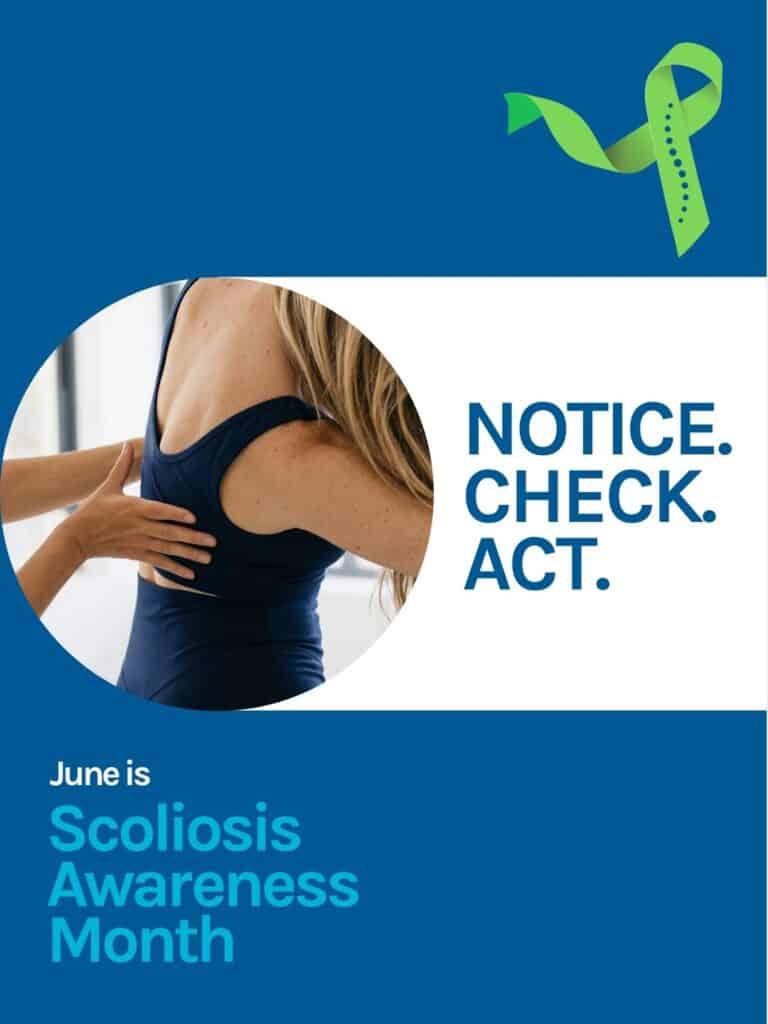
June is Scoliosis Awareness Month, and this year the message is simple: Notice. Check. Act.
That message matters because scoliosis is often not found by the person who has it first. It is usually noticed by someone close to them. A mom sees one shoulder sitting higher in a photo. A coach notices uneven posture at practice. A husband, wife, or friend sees that something just looks different.
That small moment matters more than most people realize.
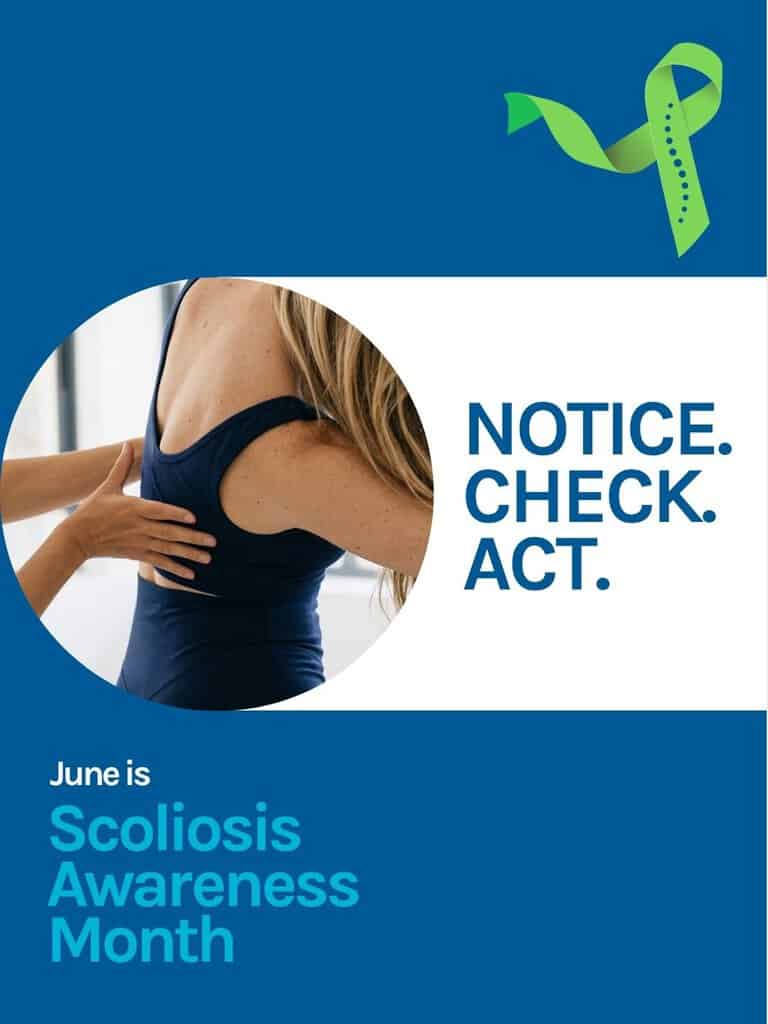
Scoliosis is easy to miss
Scoliosis is a sideways curve of the spine. It affects about 3% of people and can show up in children, teens, and adults. It is most often noticed during the growing years, especially in adolescence.
One reason it gets missed is simple: it does not always hurt. A child can have a curve that is getting worse and still say they feel completely fine. That is why early awareness matters so much. If nobody is looking, nobody knows.
Why early detection matters
When scoliosis is found early, there are often more non-surgical options to help guide care. For growing children and teens, that may include close monitoring, scoliosis-specific exercises, or bracing when appropriate. In adults, early evaluation can help explain posture changes, stiffness, imbalance, or pain and guide the right next step.
The key point is this: the sooner you know what you are dealing with, the more choices you usually have.
Waiting too long can mean:
– A curve has more time to progress
– A family spends months worrying without answers
– Care becomes more complex than it needed to be
What should you look for?
You do not need medical training to notice something unusual. You just need to pay attention.
If you are checking your child, spouse, partner, or someone else close to you, look for:
– Uneven shoulders
– One shoulder blade sticking out more
– Uneven hips
– A body lean to one side
– Clothes hanging unevenly
– A rib hump or uneven back when bending forward
These signs do not prove scoliosis. But they are good reasons to take the next step and get more information.
Who should be paying attention?
This message is for more than parents.
The first person to spot scoliosis could be:
A parent
A grandparent
A sibling
A spouse or partner
A teacher
A coach
A friend
A healthcare provider
In real life, scoliosis is often noticed in everyday moments. At the pool. In a school uniform. In a team photo. While getting dressed. During a routine visit. That is why this year’s message works so well: awareness starts with your circle.
What to do if you notice something
If something looks off, do not panic. And do not ignore it either.
Start with a simple at-home screen using the ScoliScreen app or a trusted scoliosis screening guide. If the screen raises concern, the next step is a professional scoliosis assessment.
That assessment can help answer important questions:
– Is it scoliosis or something else?
– If there is a curve, how large is it?
– Is it stable, or is it likely to change?
– Does it need treatment, monitoring, or just peace of mind?
Not every curve needs active treatment. But it is always better to make that decision from clear information, not guesswork.
A few minutes now can make a big difference later
This is what Scoliosis Awareness Month is really about.
It is about paying attention before a small change becomes a bigger problem. It is about helping families catch things earlier. It is about making sure people know that doing nothing is not the only option.
Sometimes the most important step is simply being the person who says, “That looks different. Let’s check it.”
Check your circle this June
This month, take a minute to look a little closer at the people you care about. Notice posture. Notice changes. Notice when something seems uneven.
Then take the next step.
Notice. Check. Act.
If you have noticed uneven shoulders, hips, or posture, do not wait and wonder. Get clear answers
If you are concerned about possible scoliosis, start with the ScoliScreen app or schedule an assessment with Scoliosis Center of Louisiana. Our team is here to help you get answers and understand your next best step. Call us