
Why Brace Design Determines Both Outcomes and Emotional Impact
For decades, families have been told the same story about scoliosis bracing:
“It’s uncomfortable, it’s stressful, but it’s necessary — and it might help slow the curve.”
But when you look closely at the lived experience of thousands of adolescents, a different truth emerges.
The emotional burden of bracing isn’t just about wearing plastic for 18–20 hours a day.
It’s about whether the brace actually works.
And that’s the part almost no one talks about.
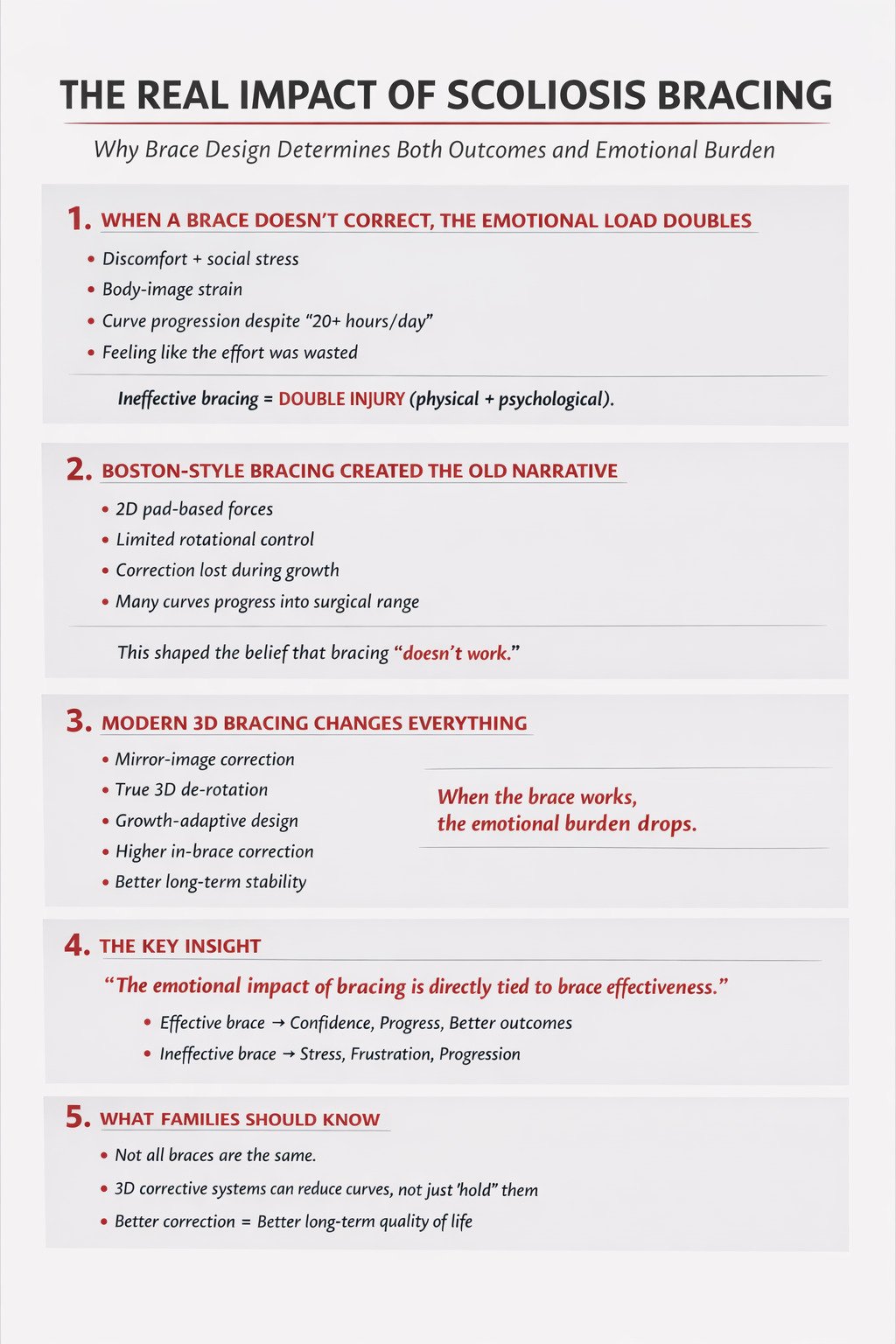
When a Brace Doesn’t Correct, the Emotional Load Doubles
Traditional braces — especially Boston‑style TLSOs — were designed in the 1970s with a simple goal: contain the curve.
Not reverse it.
Not de‑rotate it.
Not create a mirror‑image posture.
Just hold it.
When a brace can’t create meaningful 3D correction, the pattern is predictable:
- Early in‑brace X‑rays look decent
Growth happens
Pads migrate
Rotation worsens
The curve rebounds
The final curve is often worse than the starting point
And the child is left thinking:
“I wore this thing for years… and it didn’t even work.”
That’s the psychological injury surgeons rarely measure.
The emotional strain of bracing is not just the brace itself — it’s the futility of wearing a brace that was never designed to change the long‑term trajectory.
Boston Bracing Created the Narrative That Bracing “Doesn’t Work”
The classic Boston‑brace arc looks like this:
Modest early correction
Rapid loss of correction during growth
Curve progression despite “20+ hours/day”
Surgery recommended in adolescence
This pattern became so common that it shaped the entire orthopedic worldview:
“Bracing is miserable.”
“Bracing doesn’t work well.”
“Curves progress anyway.”
“Surgery is inevitable for big curves.”
But that worldview is based on the performance of a brace that cannot deliver 3D correction.
When the tool is limited, the outcomes are limited — and the emotional burden becomes heavier.
3D Corrective Bracing Changes the Entire Equation
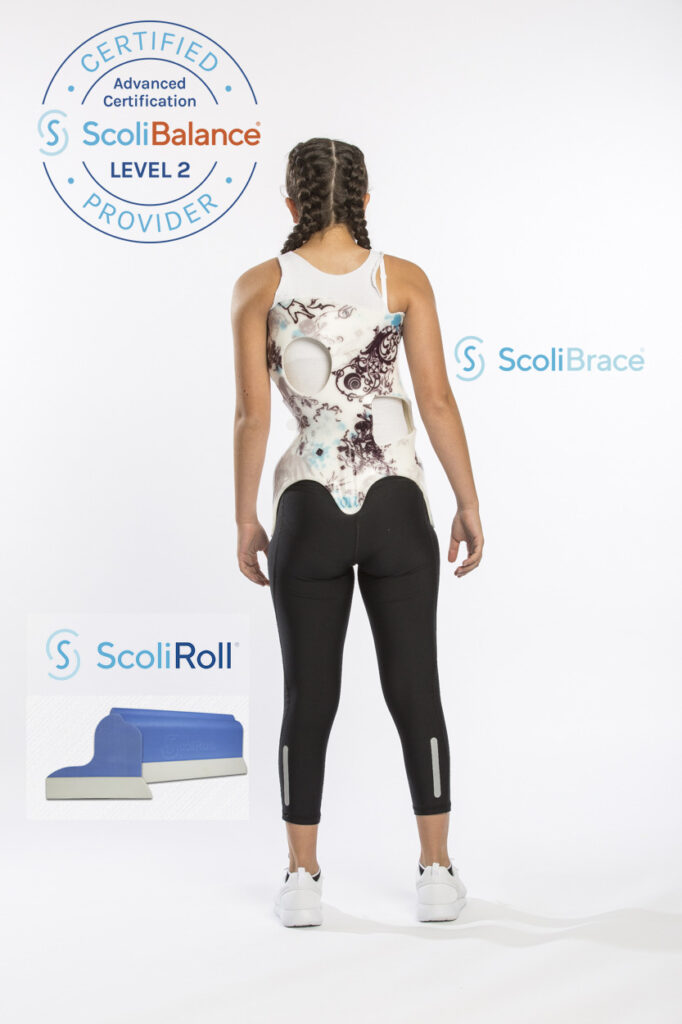
Modern 3D braces — such as CMP braces, ScoliBrace, and other CAD/CAM mirror‑image systems — are built on a fundamentally different philosophy.
They are designed to:
Reverse the curve, not just contain it
Create mirror‑image correction
Apply true 3D de‑rotation
Maintain correction through growth
Use expansion windows to allow breathing and movement
Produce higher in‑brace correction, which correlates with better long‑term outcomes
When a brace actually changes the posture, the rib cage, and the rotational component, something else changes too:
The psychological burden drops.
Why?
Because the child sees progress.
Because the brace feels purposeful.
Because the family sees the curve getting smaller, not bigger.
Because the treatment has a clear, visible effect.
A brace that works is a brace that feels worth it.
The Real Story: The Emotional Impact of Bracing Is Directly Tied to Effectiveness
This is the key insight:
The emotional burden of bracing is not inherent — it’s a function of brace effectiveness.
If a brace:
reduces the curve
improves posture
creates symmetry
and keeps the curve smaller long‑term
…then the emotional load is:
lower
shorter
and often replaced by confidence and pride.
But if a brace:
doesn’t correct
doesn’t hold correction
and the curve progresses anyway
…then the child experiences:
discomfort
social stress
body‑image strain
and curve progression
That’s a double injury — physical and psychological.
And it’s avoidable.
SECTION FOR DOCTORS
Why Brace Design Matters More Than Brace Wear Time
Orthopedic literature often emphasizes compliance as the primary determinant of brace success.
But compliance cannot compensate for insufficient corrective design.
Boston‑style TLSOs:
rely on 2D pad‑based forces
lack rotational control
lose corrective geometry as the child grows
produce modest early correction with poor long‑term retention
This creates the familiar pattern of “good in‑brace, poor out‑of‑brace” outcomes.
In contrast, 3D corrective systems:
use full‑body scanning
incorporate mirror‑image postural correction
integrate rotational forces
maintain corrective geometry through growth
achieve higher in‑brace correction, which correlates with reduced progression risk
The difference is not philosophical — it is mechanical.
Reframing the Psychological Narrative
Much of the literature on bracing and mental health is based on cohorts treated with Boston‑style braces.
These studies consistently show:
reduced self‑image
increased stress
social withdrawal
body‑image concerns
But these findings reflect the experience of wearing a brace that often fails to change the natural history of the curve.
When bracing is effective — meaning high in‑brace correction and sustained out‑of‑brace improvement — the psychological burden is significantly lower, and post‑treatment HRQoL normalizes.
The emotional impact of bracing is not universal.
It is brace‑dependent.
Clinical Takeaway
If we want to reduce the psychological burden of bracing, we must improve the effectiveness of the brace itself.
A brace that works:
improves adherence
reduces emotional strain
increases patient confidence
decreases long‑term surgical risk
A brace that doesn’t work:
amplifies stress
damages trust
and reinforces the belief that surgery is inevitable
The future of scoliosis care depends on recognizing that mechanical design drives both outcomes and patient experience.
CITATIONS
Wang H et al. (2021). Quality of Life of Adolescent Idiopathic Scoliosis Patients Under Brace Treatment: A Brief Communication of Literature Review. Qual Life Res 30(3):703‑711.
Cheung PW et al. (2019). An Insight Into the Health‑Related Quality of Life of Adolescent Idiopathic Scoliosis Patients Who Are Braced, Observed, and Previously Braced. Spine 44(10):E596‑E605.
Peiró‑García A et al. (2024). Impact on Quality of Life of Full‑Time and Night‑Time Braces in Adolescent Idiopathic Scoliosis. Spine.
Misterska E et al. (2013). Perception of Stress Level, Trunk Appearance, Body Function and Mental Health in Females With Adolescent Idiopathic Scoliosis Treated Conservatively. Qual Life Res 22:1633‑1645.
Grossman DC et al. (2018). Screening for Adolescent Idiopathic Scoliosis: Evidence Report and Systematic Review for the USPSTF. JAMA 319(2):173‑187.
İşçi H et al. (2025). Understanding Bracing Outcomes in Adolescents With Idiopathic Scoliosis: A Mixed‑Methods Approach. Front Rehabil Sci 6:1625736.
Schwieger T et al. (2016). Body Image and Quality‑of‑Life in Untreated Versus Brace‑Treated Females With Adolescent Idiopathic Scoliosis. Spine 41(4):311‑319.
Schwieger T et al. (2017). Body Image and Quality of Life and Brace Wear Adherence in Females With Adolescent Idiopathic Scoliosis. J Pediatr Orthop 37(8):e451‑e637.